CONTENT HUB
Isidore - developing AI to understand our solar system
As we move into the next quarter of this century, the challenges facing our planet - from climate volatility to solar storms - have grown in both frequency and complexity. We have reached a pivotal moment where the bottleneck for scientific breakthroughs is no longer just human ingenuity. It is the sheer scale of computation and data orchestration required to process the numerous sources and scope of the information available to us.
The FDL Europe (2018 - 2023) and Earth Systems Lab (2024 - 2025) research initiatives have served as a primary engine for tackling problems on the frontier of space, our planet and AI. Since 2020, the partnership between Scan, the Frontier Development Lab (FDL) and the European Space Agency (ESA) has proven that when you remove the constraints of compute and storage, you remove the constraints on discovery. By providing cloud-based high-performance compute infrastructure capable of training massive AI models, Scan has enabled scientists to move beyond theoretical research into the realm of actionable, real-time planetary defence and Earth systems management.
From Digital Twins to 3D Extremes
What started as attempting to better understand specific weather and climate attributes using historical data from ESA's fleet of satellites has turned into advanced 2D and 3D models of entire systems such as forest biomass cover, cloud formation and evolution, and flood prediction and monitoring. These models have often delivered landmark frameworks for use by subsequent researchers to build on, including Pyrocast, RaVÆn, ICARUS, Floodcast AI and FloodBrain.
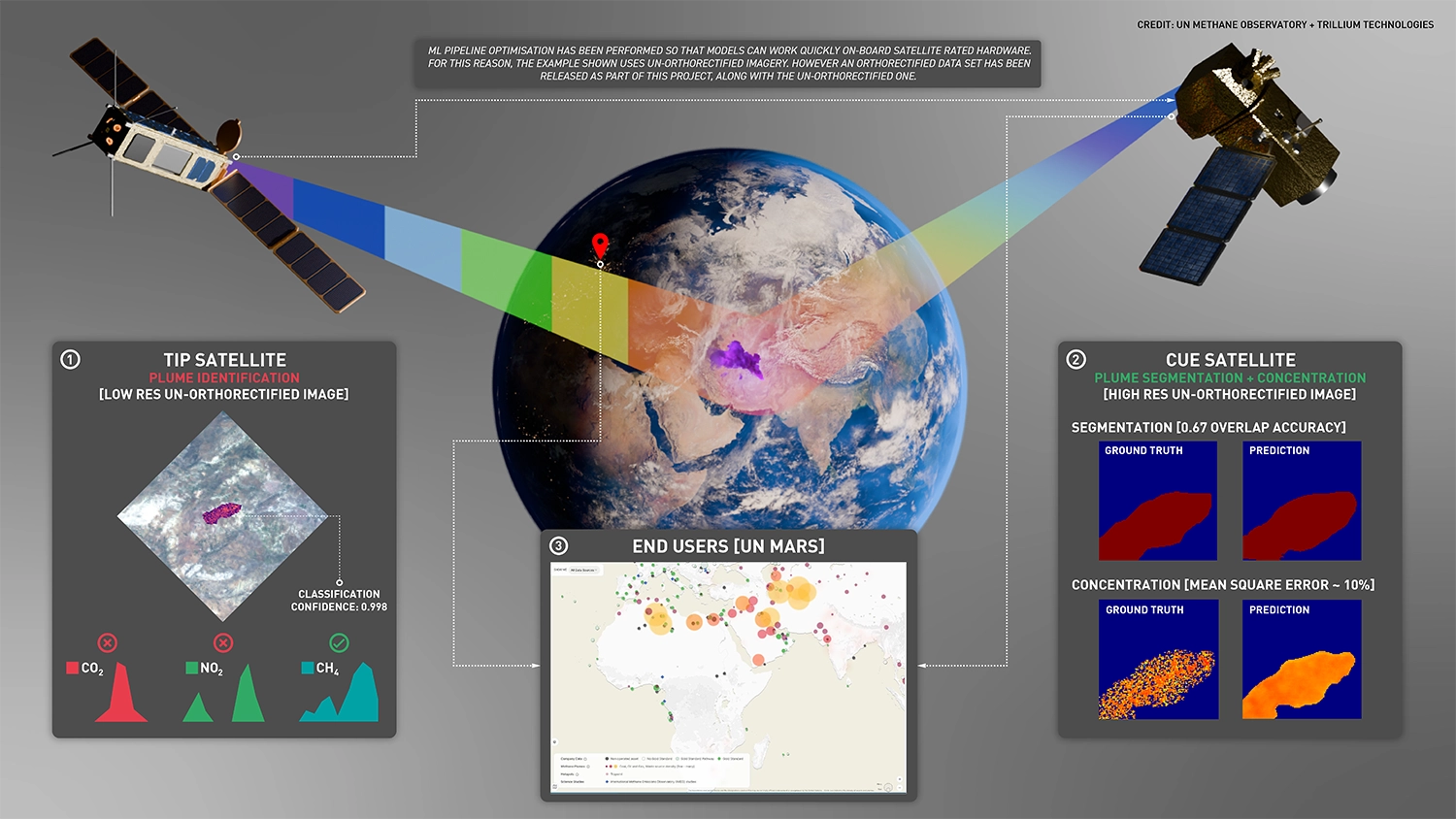
Last year's research went even further to develop three novel solutions. Firstly, a 'tip' and 'cue' implementation of twin onboard edge AI deployments, to deliver near real-time predictions for methane plume detection, bypassing the lengthy delays of traditional ground-based processing.
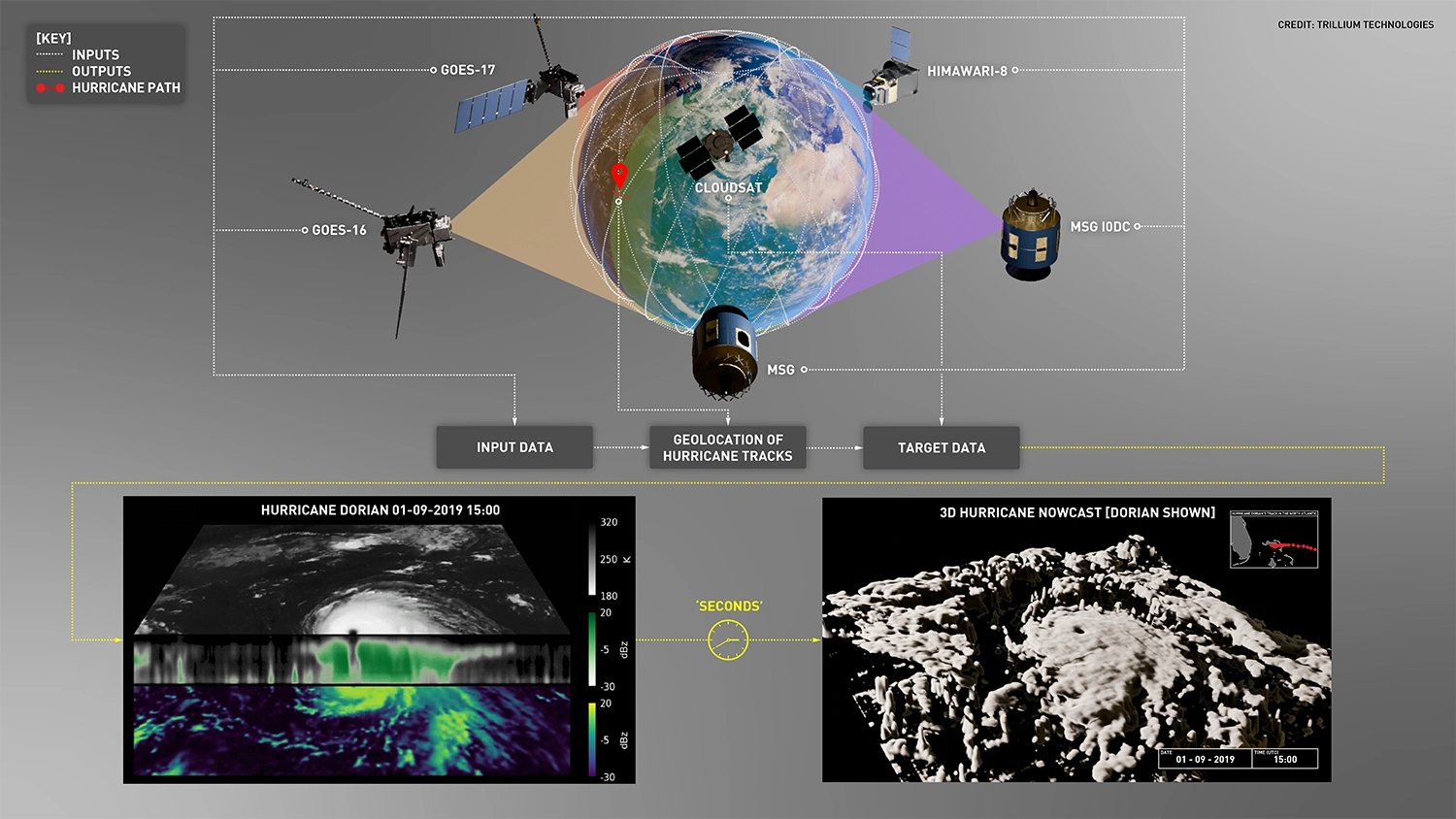
Secondly, the development of a sensor-independent ML pipeline that reconstructs the internal 3D structure of tropical cyclones, providing a breakthrough in predicting storm intensification where direct observations were previously missing. This research won an ML Innovation award at NeurIPS 2025 - an annual conference on Neural Information Processing Systems that attracts 15-20,000 researchers, industry professionals, and students.
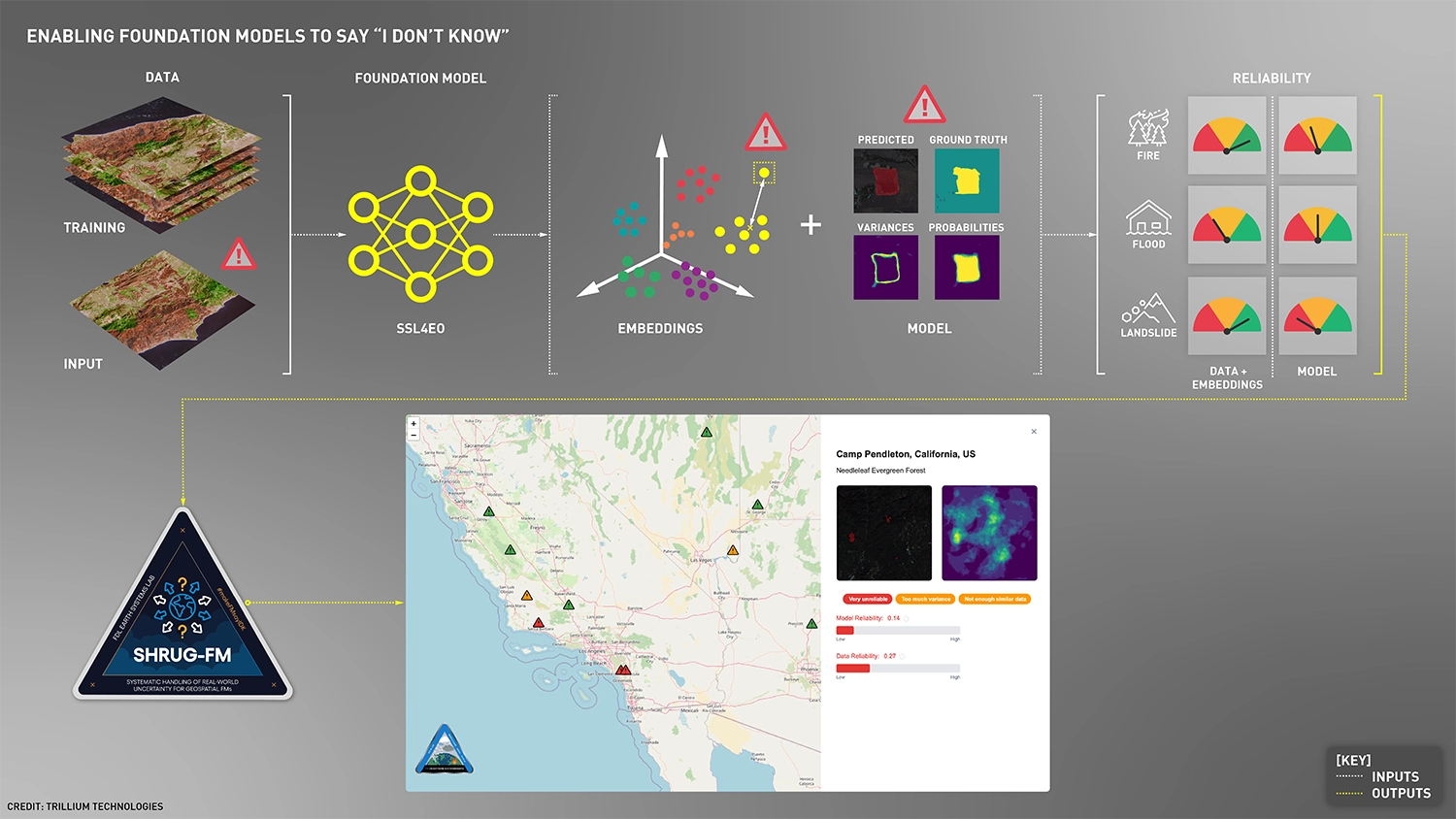
Finally, to ensure foundation models remain reliable in the harshest environments, a new SHRUG-FM framework was introduced to create foundation models that can ‘flag’ their own uncertainty, ensuring AI-driven decisions are as safe as they are fast.
Orchestrating Science through SpaceML.org
While these latest individual breakthroughs are hugely significant, these and the previous five years’ research existing in isolation is no longer enough. To truly address interconnected global challenges, there is a need for orchestrated results that deliver insight across projects. The primary barrier to this unified science platform has traditionally been data entropy, where research outputs live and die within the lifecycle of a single challenge. To break this cycle, FDL worked with Scan to design and build a bespoke NAS system that acts as a cornerstone of shared knowledge, providing:
- A modular design and scalability - ensuring the infrastructure can scale seamlessly as datasets evolve into the petabyte range
- Redundant architecture - guaranteeing years of high-value scientific research remains protected against data loss and corruption
- A pathway to GPU cluster - architecture enabling future addition of GPU servers to allow for ‘compute-on-data' workflows, with burst capacity into the Scan Cloud environment
This high-performance storage platform will also serve to centralise the research findings of the US-based FDL research initiatives - Heliolab and Lunarlab, supported by NASA. This will be hosted at SpaceML.org and this ensures that the outputs of past challenges are not just archived, but are living datasets ready to fuel the upcoming years of discovery. In the spirit of the SpaceML mission, this foundational storage platform has been named after Isidore of Seville. This early 7th-century scholar dedicated his life to gathering and preserving knowledge, assembled extracts of many books from classical antiquity that would otherwise have been lost.
In the same spirit, the Isidore repository will form a vital part of the larger SpaceML ecosystem, a community-driven initiative championing open science by providing a persistent home for AI-ready datasets and pre-trained models. Explore the FDL achievements of the last six years below.
| RESEARCH AREA | PROJECT / YEAR | CHALLENGE | BREAKTHROUGH |
|---|---|---|---|
| Foundation Models & Embeddings | World Food Embeddings (2021) | Tracking global food supply in real-time | AI-driven global map of agricultural productivity |
| Disaster Adaptors (2023) | Sifting through massive historic disaster data | FloodBrain - an LLM for rapid info collation for response teams | |
| Generalisable SSL SAR (2023) | SAR models to address downstream tasks | Improved transferability between models without retraining | |
| SAR-FM (2024) | Complex Synthetic Aperture Radar (SAR) data alignment | A Foundation Model for SAR, improving landcover identification | |
| SHRUG-FM (2025) | Poor Foundation model performance in out-of-distribution regions | SHRUG-FM - a framework that 'shrugs' or flags uncertain predictions | |
| Lunar-FM (2025) | Fragmented lunar data in disparate forms and resolutions | Lunar-FM - a foundation model combining 18 datasets with an agentic AI NLP overlay | |
| Earth Systems & Climate | Digital Twin Earth (2020) | Fusing simulated and physical data for forecasts | Improved rainfall prediction via satellite/physical model merging |
| Clouds & Aerosols (2020) | Quantifying aerosol impact on cloud structure | Used geostationary data to map climate cooling uncertainties | |
| RaVÆn / Extreme Events (2021) | Static hazard maps and downlink latency hinder real-time disaster response | RaVÆn model - an unsupervised Variational AutoEncoder (VAE) for onboard change detection, outperforming baselines in identifying hurricanes, wildfires, and floods | |
| Live Twin Hydrology (2022) | Predicting flash floods faster than physics models | Floodcast AI - global river flood predictions up to 3 days ahead | |
| Pyrocast / Live Twin Aerosols (2022) | Wildfire-induced storm clouds are unpredictable and inject stratosphere altering aerosols | Pyrocast - an end-to-end CNN pipeline to monitor and forecast pyrocumulonimbus events with a 6-hour horizon | |
| 3D Forests (2024) | Estimating forest biomass accurately | 3D tomographic mapping using P-band SAR to verify carbon sequestration | |
| 3D Clouds (2024) | 2D maps lack vertical data for weather precision | Multi-sensor fusion for 3D atmospheric modeling | |
| 3D Clouds for Extremes (2025) | Poor representation of cyclone microphysics | 3D cyclone reconstruction - inferring internal storm structure from cloud-tops | |
| STARCOP 2.0 (2025) | Delays in methane leak detection | Onboard 'Tip and Cue' - vision transformers (ViT) on spacecraft for real-time plume detection | |
| Space Weather | Live Twin Space Weather (2023) | Better prediction of threats from Coronal Mass Ejections (CMEs) | ICARUS pipeline: - onboard AI for 3D CME hazard estimation |
| Solar Eruptions (2024) | Predicting trajectory of solar storms | Enhanced early warning systems via L5 Lagrange point and CME evolution mapping |