
NVIDIA Five-Layer AI Cake: Energy, Chips, Infrastructure, Models and Applications

AI is a Five-Layer Cake

Explore the five critical layers powering modern AI systems and discover SCAN solutions across Energy, Compute, Infrastructure, Models and Deployment

Cake Diagram
Feature demonstration with highlighted components

This is an example image caption that provides context

Traditionally, data had to be carefully structured for use with specific software.

AI redefines how computers process data, as it has the ability to take raw unstructured data and extract meaning from images, text and audio.

These powerful abilities mean that for the first time in computer history, intelligence is being produced in real time, so the entire computing stack beneath it has to be reinvented. This is why the term AI Factory has been coined - to define the entire infrastructure designed to leverage open source software and produce intelligence at scale.

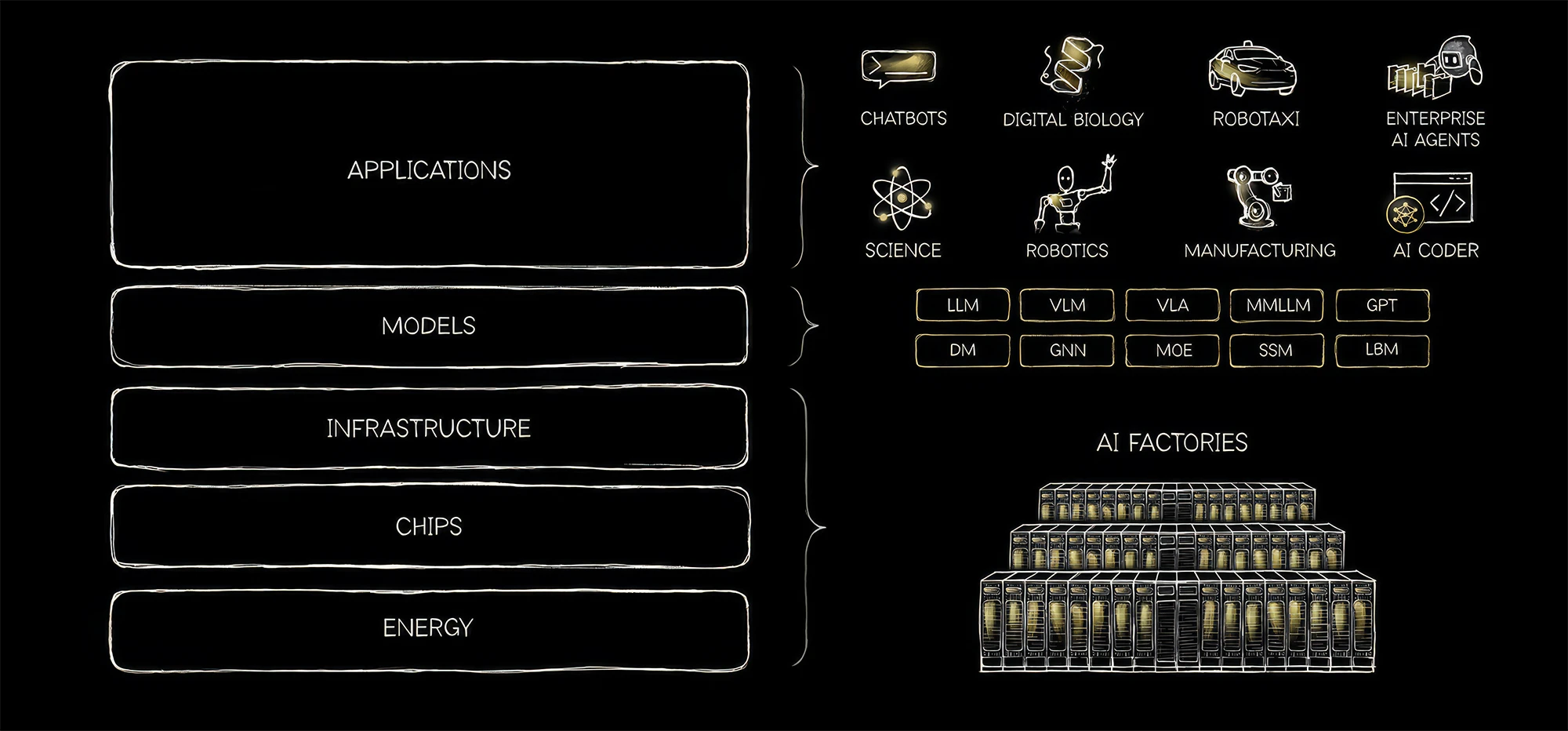
NVIDIA sees the reinterpretation of the compute stack as a five-layer cake comprising:

Energy keyboard_arrow_right Chips keyboard_arrow_right Infrastructure keyboard_arrow_right Models keyboard_arrow_right Applications

Where all layers influence and rely on the ones above and below to create an effective ecosystem of parts delivering this real-time intelligence at scale. Let's explore further.

Application layer of the AI five-layer cake

Applications

At the top of the five layers are applications, where the economic value of intelligence is created. Examples include LLMs that analyse disparate medical information, agentic AI models providing personalised customer service, better understanding the Moon, and physical AI solutions such as self-driving cars and assistance robots.

Explore our portfolio of case studies demonstrating how Scan has helped customers like you deploy AI applications across a wide range of industries.

Ideal For: Automated Visualisation Autonomous Vehicles Assistance Robots
Explore AI Solutions
Model layer for training and deploying AI systems

Models

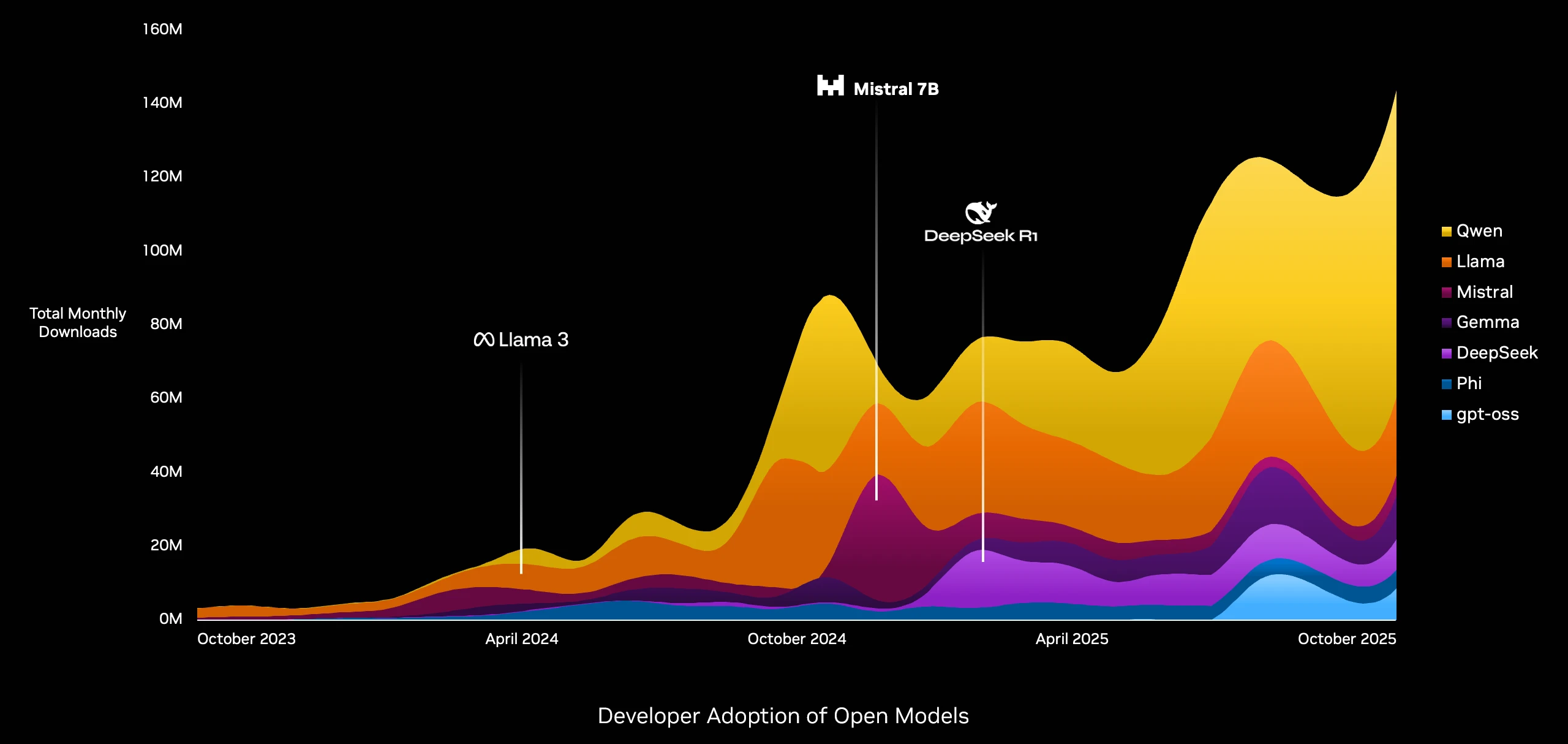
Once the systems and infrastructure are in place, AI frameworks and libraries act as the building blocks of generating intelligence. Designed to act as the basis for many use cases such as languages, biology, chemistry, physics, finance, medicine and the physical world itself, they accelerate the development of every type of application.

Explore the range of frameworks and libraries offered within the NVIDIA AI Enterprise platform.

Ideal For: Generative AI Agentic AI Physical AI

Explore AI Solutions
Infrastructure layer supporting open AI models

Infrastructure

Infrastructure encompasses everything that supports the AI factory - the facilities including power delivery, cooling and network connectivity to the wider world. These essential services determine how energy and data is provided to the chips within systems resulting in the production of intelligence at scale.

Explore our datacentre partners, hosting AI factories with sustainable power & cooling, and our range of professional services providing installation, configuration, compliance, security and management of your AI systems.

Ideal For: Omniverse Digital Twins Secure Hosted AI Cloud & Hybrid Compute

Explore AI Solutions
Chip layer of the AI five-layer cake

Chips

AI workloads require enormous parallelism, high-bandwidth memory and fast interconnects. Chips - whether they be CPUs, GPUs or DPUs - are being redesigned because their processing speed and interconnects within server systems determines how fast intelligence can be scaled and how affordable it becomes.

Explore our range of GPU-accelerated server hardware, optimised storage and low-latency networking to build your advanced AI factory infrastructure.

Ideal For: Development Training Inferencing

Explore AI Solutions
Energy layer of the AI five-layer cake

Energy

The foundation of this new five-layer concept is energy. It underpins the whole process of generating AI models at scale. Ultimately the cost of energy production heavily impacts the cost per AI token, so the greener, more sustainable sources you use to power AI factories, the greater you can scale them.

Ideal For: Scalability Sustainability Availability

Explore AI Solutions

NVIDIA’s concept of these five interconnected layers supports that AI is growing in scale and crossing international borders as countries develop their own initiatives and collaborate with each other. Far from a fleeting tech bubble, there are almost daily developments across the AI spectrum and you can keep abreast of them by exploring our monthly AI Newsletter, blogs, stories and press release within the Scan Presszone.


Scan is the UK’s leading NVIDIA Elite partner and the only certified NVIDIA DGX Managed Services Provider (MSP). To discuss your AI projects or challenges, don’t hesitate to contact our experts on 01204 474210 or at [email protected].

Frequently Asked Questions

Answers to common questions about NVIDIA's five-layer AI cake, AI factories and the wider Scan AI ecosystem.

The NVIDIA five-layer cake is a concept introduced by CEO Jensen Huang in early 2026 that defines the AI ecosystem as full-stack industrial infrastructure, rather than just software. It highlights that successful AI requires a coordinated approach across all its layers: energy, chips, infrastructure, models and applications.

NVIDIA CEO Jensen Huang describes a five-layer AI cake: energy, chips, infrastructure, models and applications. Each layer depends on the others to generate intelligence at scale. These five layers are translated into elements of Scan's AI ecosystem.

NVIDIA CEO Jensen Huang describes a five-layer AI cake: energy, chips, infrastructure, models and applications. Each layer depends on the others to generate intelligence at scale. These five layers are translated into elements of Scan's AI ecosystem.

NVIDIA CEO Jensen Huang describes a five-layer AI cake: energy, chips, infrastructure, models and applications.

  1. Energy - the foundational layer, emphasising that AI requires massive electricity for datacentres and grid management.
  2. Chips - the hardware layer, including GPUs, CPUs and networking that process AI workloads.
  3. Infrastructure - the datacentre architecture that supports the AI hardware.
  4. Models - the building blocks for AI applications.
  5. Applications - the end-user layer where economic value is created, such as digital agents, drug discovery and robotics.

You can learn more by reading this page, and understand how these layers relate to Scan's range of products and services within its AI ecosystem.

Most of the elements of NVIDIA's five layer cake can be purchased from Scan as part of our AI ecosystem.

  1. Energy - provided by the National Grid.
  2. Chips - explore our range of GPU-accelerated server hardware, optimised storage and low-latency networking.
  3. Infrastructure - explore our datacentre partners and our range of professional services.
  4. Models - explore the range of frameworks and libraries.
  5. Applications - the end-user output. Explore our portfolio of case studies.

AI tokens are the fundamental units of data - parts of words, whole words or punctuation - that Large Language Models (LLMs) process to understand and generate text. Think of them as building blocks or syllables for AI, where roughly 1,000 tokens equal about 750 English words. Tokens are used to measure input and output, determine costs, define model context limits and compare solutions.

Intelligence refers to the resulting AI applications that are created by AI factories. These outputs are the final result that can be used to drive commercial value, increased insight or competitive edge.

AI factories are the next stage in the evolution of the datacentre. While existing datacentres store vast amounts of mission-critical corporate or public sector data, AI factories provide competitive advantage by transforming data into actionable real-time insights.

Instead of data being the product, in AI factories intelligence is the product. AI factories achieve this by orchestrating AI projects from data preparation through training, fine-tuning and inferencing. The latter two stages are particularly important as this is where intelligence is made.