
King's College London & AI Centre for Value Based Healthcare
King's College London & AI Centre for Value Based Healthcare
Implementation of the Federated Learning Interoperability Platform (FLIP) across multiple NHS Trusts to accelerate algorithm training and improve patient diagnosis
UPDATED 18 MARCH 2024
The AI Centre for Value-Based Healthcare (AI Centre) is a consortium of academic, NHS and industry partners led by King's College London (KCL) and based at St Thomas' Hospital. The AI Centre's partner organisations include University College London (UCL), Imperial College London, Queen Mary's University London and the Health Innovation Network, supported by numerous industry partners including Scan and NVIDIA.
The diverse research teams within the AI Centre develop and train sophisticated AI algorithms from a vast wealth of NHS medical images and patient pathway data to create new healthcare tools powered by federated learning, to provide faster diagnosis, personalised therapies and effective screening across a range of conditions and procedures. AI algorithms perform better when they have more data to train on, but it must be remembered healthcare patient data is highly confidential and sensitive.

Project Background
In July 2019, the Scan AI team led a proof of concept (POC) with Kings College London to design a GPU-accelerated compute cluster to develop AI-powered medical imaging at the point of care. In contrast to traditional medical testing, which involves sending scans for further analysis by specialists, point of care testing allows the results gained from X-rays, CT scans or MRI to be delivered and analysed immediately, in real-time with the patient-clinician interaction. The POC success resulted in reference cluster design of an NVIDIA DGX A100, an 3XS EGX A30 and a 210TB NetApp AFF A800 storage array. This supported the development of the Artificial Intelligence Development Engine (AIDE) firmware, installed on the first cluster at King's College Hospital NHS Foundation Trust in October 2021.
Following the validation of proof of concept system design it was decided to add a Run:ai software layer onto the cluster to further increase GPU utilisation. Run:ai enables flexible resource management and consumption so that users can easily access GPU fractions, multiple GPUs or clusters of GPUs for workloads of every size and stage of the AI lifecycle.

Subsequently, in October 2021 AIDE clusters were also installed at University College London NHS Foundation Trust and at Guy's and St Thomas' NHS Foundation Trust. These were followed by Imperial College Healthcare NHS Trust in January 2022, and University Hospital Sussex NHS Foundation Trust in February 2022. You can learn more about this phase in our AIDE project case study.
The Federated Learning Interoperability Platform
Following the launch of AIDE, the Federated Learning Interoperability Platform (FLIP) was developed to expand the training datasets using a federated server to train models on locally available patient data at each Trust, whilst retaining anonymity and confidentiality. To facilitate this the existing five AIDE clusters were installed with the FLIP firmware so they would act as the federated servers, whilst smaller clusters were scheduled to be installed in a further five NHS Trusts, to create anonymised dataset coverage over 18 million patients. These smaller clusters were made up of an NVIDIA-certified 3XS EGX A30 server and a 45TB PEAK:AIO software-defined storage appliance.


The FLIP solution allows AI researchers to develop clinical applications on NHS patient data without the information ever leaving the local Trust network. There is no transferring of any confidential information out of each NHS Trust, which means that researchers can train their applications on vastly more data without compromising sensitive patient data. FLIP also incorporates dedicated secure data storage for processing and analysis within each NHS Trust. Data from across the Trusts' patient records systems will be transferred into this secure enclave for curating and aggregation, unifying medical imaging scans from Picture Archiving and Communications Systems (PACS) — the industry-standard storage system incorporating different medical imaging types — and other electronic health data.
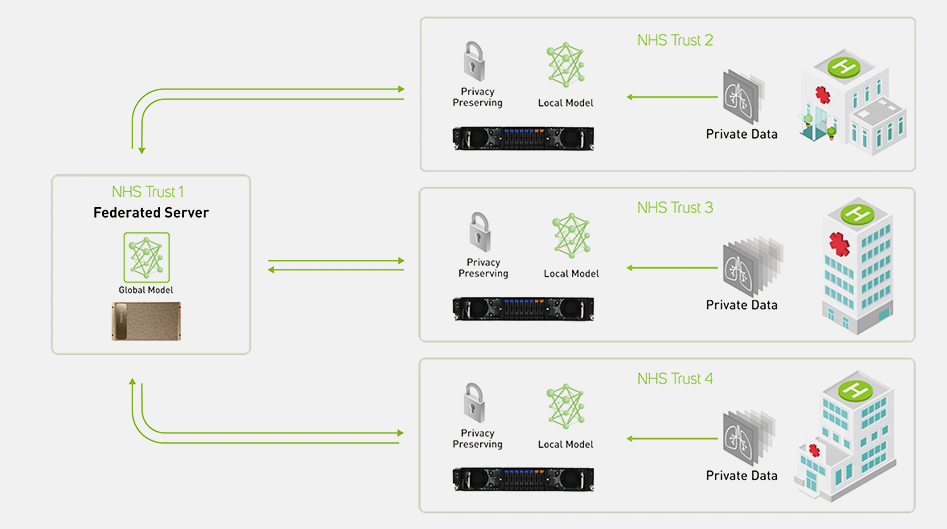
Throughout 2022, smaller AIDE clusters were installed at East Kent Hospitals University NHS Foundation Trust, Lewisham and Greenwich NHS Trust and Barts Health NHS Trust. In 2023, the original King's College London POC DGX-2 cluster was relocated to a London datacentre for installation of the AIDE and FLIP layers, improved management and monitoring, reconfiguration of the NetApp array, refreshment of the network switches and installation of an updated Run:ai image.
Next Steps
During 2024, further expansion of the AIDE / FLIP solutions are scheduled, to complete the ten London-based sites. This is accompanied by a planned expansion outside the capital for the first time, with the federated learning concept scheduled for installation at the University Hospitals Birmingham NHS Foundation Trust, early in the year.
Check back here to see how this multi-year project expands further.
The Scan Partnership
Scan has been the glue between the collaborative partners at every stage of this multi-year, consistently-evolving project. Coordination and communication with KCL, the AI Centre, NVIDIA, NetApp, Run:ai and the wider NHS Trust community has proved critical in the smooth delivery of each element of this GPU-accelerated solution, enabling improved diagnostics and patient care for ten million NHS users.
Scan initiated the guided POC and was instrumental in design of the first DGX cluster supporting its installation, upgrades and monitoring. For the AIDE clusters, Scan and its in-house 3XS Systems division developed a bespoke NVIDIA-certified EGX server to integrate with NVIDIA servers and networking, again installing and maintaining on each NHS site. All these hardware deployments have been further supported by Scan's system engineers and data science consultancy team.
Project wins
Accelerate diagnosis from CT and MRI scans with real-time AI analysis
Enhanced detection and faster diagnosis of prostate cancers and stroke conditions
Image analysis in real-time for improved clinician-patient interaction at point of care

Prof. Sebastien Ourselin
Head of Biomedical Engineering & Imaging Sciences, KCL
"It has been fantastic working with these companies, especially through the guidance of Scan, who have been not only supporting the decisions of what solutions we should embed in our NHS Trust, but to put them together to build a turnkey solution."

Dr M. Jorge Cardoso
CTO, London Medical Imaging and AI Centre for Value Based Healthcare
"With Run:AI we've seen great improvements in speed of experimentation and GPU hardware utilisation. Reducing time to results ensures we can ask and answer more critical questions about people's health and lives."

Beverley Bryant
CIO, Guy's and St Thomas' and King's College Hospital NHS Foundation Trusts
"We are delighted at the research and input from our consortium members. Working with a technology partner has expedited the launch of AIDE. This is just the beginning as we support the transformation of clinical diagnosis and treatments to be shared across the NHS and exported internationally"
Speak to an Expert
You've seen how Scan continues to help Kings College London and the AI Centre for Value Based Healthcare accelerate medical diagnosis through AI. Contact our expert AI team to discuss your healthcare AI project requirements.
Related content
View more case studies
KCL AI Centre
Learn more about the London Medical Imaging and AI Centre for Value Based Healthcare and discover their cutting-edge research initiatives.
Read More
Funding AI for the NHS
£16m grant for the London Medical Imaging and AI Centre for Value Based Healthcare to accelerate AI deployment across NHS Trusts.
Read More
KCL and Cambridge-1 Collaboration
Discover how KCL accelerates synthetic brain 3D image creation powered by the Cambridge-1 supercomputer.
Read More