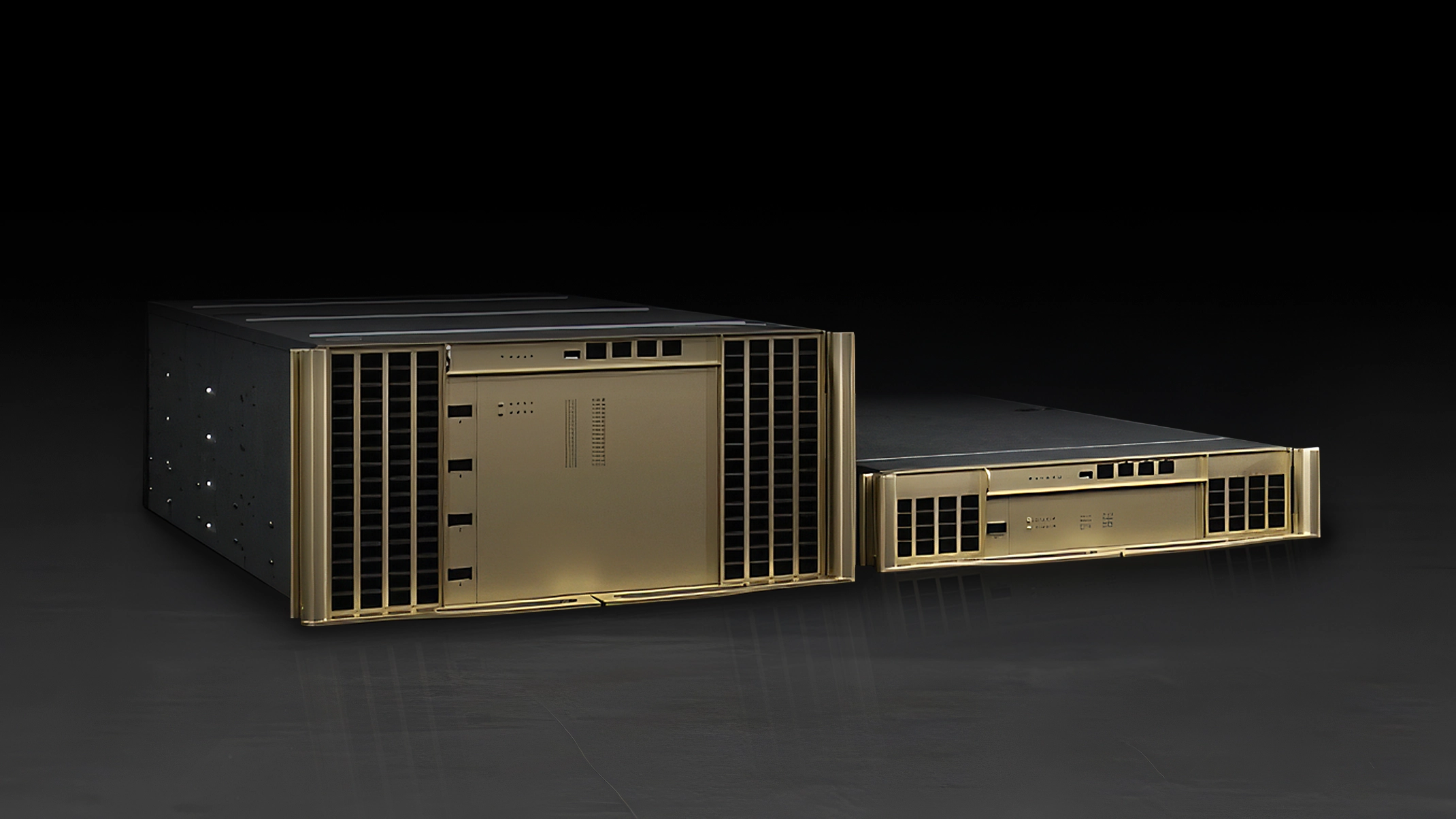
NVIDIA Networking for AI and HPC

Demanding AI and HPC workloads require networking infrastructure that provides rapid data transfer between storage systems and GPU-accelerated servers. This is achieved by connecting these devices with specialised high-throughput, low-latency switches and network interface cards.

This type of networking hardware is manufactured by NVIDIA (following its acquisition of Mellanox in 2020), complementing DGX, HGX, MGX and EGX server platforms. Learn more in our AI Training Buyers Guide.

NVIDIA networking switch

This guide covers NVIDIA Quantum and Spectrum network switches plus NVIDIA ConnectX Smart NICs, Super NICs and BlueField DPUs for AI and HPC workloads. For traditional office and enterprise networking, read our Network Switches Buyers Guide and Network Cards Buyers Guide.

NVIDIA ConnectX network card`

Network Topology

Datacentres designed for AI and HPC and workloads employ a specific type of network topology known as spine-leaf architecture. It is a two-tier network architecture where leaf switches connect to clusters of GPU-accelerated servers and spine switches connect to all leaf switches. The spine layer is built with three or more switches, but there are no connections between spines as the two switch levels are connected using routing fabric.

For larger networks, leaf switches can be incrementally added and aggregated with the spines layer to create a POD. To scale-up the datacentre multiple PODs are connected via another layer of switches - called super-spines. These two architectures are illustrated below.

Two-tier network architecture

Two-tier network architecture

Three-tier network architecture

Three-tier network architecture

These spine-leaf and super spine-spine-leaf network architectures offer higher performance and scalability than the traditional datacentre network architecture with access, aggregation, and core layers, as highlighted in the table below.

Feature Traditional Architecture Spine-Leaf Architecture
Layers Three tiers: access, aggregation, and core Two tiers: spine and leaf
or
Three tiers: super spine, spine and leaf
Interconnection Hierarchical connections: Access connects to aggregation; aggregation connects to core Every leaf switch connects to every spine switch
Traffic Flow Primarily designed for north-south traffic (end-user to datacentre) Optimised for east-west traffic (server-to-server) with lower, predictable latency
Scalability Less scalable; requires significant re-architecting for growth Highly scalable; add more switches to either layer - scale-out without re-architecting
Path Utilisation Relies on Spanning Tree Protocol (STP) routing to block redundant links, creating oversubscribed paths Uses Equal Cost Multi Path (ECMP) routing to load balance traffic across all available paths simultaneously
Cabling Fewer cables, but potentially less efficient use of bandwidth Requires more cabling overall
Performance Higher latency and potential bottlenecks at the aggregation layer Lower latency and higher throughput due to fewer hops

Spine-leaf architectures support both InfiniBand and Ethernet. NVIDIA separates these protocols into two switch families: Quantum for InfiniBand and Spectrum for Ethernet.

Network Protocols

Traditionally InfiniBand was the choice of HPC and AI users, since it offered better throughput and lower latencies by offloading several functions onto the NIC rather have them carried out by the host CPU. In recent years, the Ethernet protocol has mirrored these offloading capabilities so the technologies offer similar performance.

NVIDIA Quantum for InfiniBand

NVIDIA Quantum for InfiniBand

It is fair to fair to say that InfiniBand is still the first choice for the most demanding AI workloads. It was designed from the ground up to support ultra-low latency and high throughput through technologies such as remote direct memory access (RDMA) that allows high-speed access to the memory of connected systems, bypassing the CPU(s) of either. InfiniBand is also lossless by design which means delays due to data packet loss are avoided, delivering predictable and reliable performance without requiring extensive tuning through quality-of-service (QoS) processes. That said, the specialist nature of the hardware can make it expensive, and dedicated InfiniBand knowledge is required to support it.

Version Transfer Rate
Gigabits per Second Gigabytes per Second
FDR 54 6.75
EDR 100 12.5
HDR 200 25
NDR 400 50
XDR 800 100
NVIDIA Spectrum for Ethernet

NVIDIA Spectrum for Ethernet

Ethernet is the older traditional networking protocol, offering cost-effective but slower connectivity. Recent advancements such as remote direct memory access-over-converged Ethernet (RoCE) have acted to provide the same high-speed memory access without CPU overhead that InfiniBand has always enjoyed, so has levelled the playing field to a large extent. However, these breakthroughs are built on adapting and evolving a long-standard protocol rather than being innate in its design, hence why InfiniBand is still promoted as the protocol of choice - especially in the most demanding scenarios. That said, Ethernet is a well-known protocol so requires little specialist knowledge.

Version Transfer Rate
Gigabits per Second Gigabytes per Second
50GbE 50 6.25
100GbE 100 12.5
200GbE 200 25
400GbE 400 50
800GbE 800 100

It is worth pointing out that NVIDIA Quantum and Spectrum switches, and ConnectX NICs are backwards compatible with slower InfiniBand and Ethernet speeds, however most AI and HPC workloads today require at least around 100Gb/s, with applications such as LLMs, generative AI, agentic AI and physical AI require ever increasing throughput due to the vast datasets and time required to train them.

Port Types

Both NVIDIA Quantum and Spectrum network switches use small form-factor pluggable (SFP) ports, which employ fibre optics to allow for the fastest data transmissions over the greatest distances. However, as speeds increase though the various generations of InfiniBand and Ethernet, enhanced versions have been designed including the four-channel QSFP (quad small form-factor pluggable), the QSFP-DD (double density) and the eight-channel OSFP (octal small form-factor pluggable). The latest NVIDIA switches remove the need for transceivers altogether, beading photonics to the die and employing MPO (multi-fibre push-on) connectors. The below table shows speeds and compatibilities.

NVIDIA switch with QSFP ports
Speed SFP56 QSFP+ QSFP28 QSFP56 QSFP56-DD QSFP112 OSFP MPO
50Gb/s
100Gb/s
200Gb/s
400Gb/s
800Gb/s

These ports types are also mirrored on NVIDIA ConnectX Smart NICs, Super NICs and BlueField DPUs, as their throughput capabilities increase in line with the switches.

Switch and NIC Specifications

NVIDIA Quantum InfiniBand switches are available in various generations, defined by increasing performance and addition features. They are complemented by NVIDIA ConnectX Smart NICs, Super NICs and BlueField DPUs. Click the tabs below to explore the range.

Quantum X800 Switches

NVIDIA Quantum X800 switches are purpose-built for trillion-parameter-scale agentic and physical AI models, delivering 800Gb/s of end-to-end connectivity with ultra-low latency. They feature in-network compute acceleration technologies such as NVIDIA SHARP v4 (Scalable Hierarchical Aggregation and Reduction Protocol), which offloads collective communications (from AI training applications) from CPUs and GPUs directly onto the Quantum InfiniBand network. Some models also feature co-packaged optics, replacing pluggable transceivers with silicon photonics on the same die as the ASIC. This innovation provides 3.5x better power efficiency and 10x higher network resiliency.

NVIDIA Quantum-X800 Q3400-RA InfiniBand switch

NVIDIA Quantum-X800 Q3400-RA InfiniBand switch

NVIDIA Quantum-X Photonics InfiniBand switch

NVIDIA Quantum-X Photonics InfiniBand switch

Model Switch Backbone Switch Ports Performance OS & Management Cooling Secure Boot
Q3200-RA 72x XDR, up to 28.8Tb/s 36x OSFP 72x XDR 800G UFM External Air
Q3400-RA 144x XDR, up to 115.2Tb/s 72x OSFP 144x XDR 800G UFM External Air
Q3401-RD 144x XDR, up to 115.2Tb/s 72x OSFP 144x XDR 800G UFM External Air
Q3450-LD 144x XDR, up to 115.2Tb/s 144x MPO 144x XDR 800G UFM External Liquid / Air

OS and Management

All Quantum X800 switches are externally managed via NVIDIA Unified Fabric Manager (UFM). This platform revolutionises datacentre network management by combining enhanced, real-time network telemetry with AI-powered cyber intelligence and analytics to support scale-out, InfiniBand-connected infrastructures. As UFM is also included in the software stack of NVIDIA DGX SuperPOD solutions, it is designed as a single universal management layer for your entire GPU-accelerated cluster.

Compatible Network Cards

NVIDIA ConnectX-8 Super NIC

ConnectX-8 Super NIC

XDR 800G

ConnectX-8 Super NICs are a specialised card optimised to accelerate network traffic for AI workloads. They are built around a high-performance network ASIC, making them more streamlined and energy efficient versus a DPU, prioritising GPU-to-GPU communication while minimising CPU overhead and latency.

NVIDIA ConnectX-9 Super NIC

ConnectX-9 Super NIC

GDR 1600G

ConnectX-9 Super NICs are the next generation of specialised card optimised to accelerate network traffic for AI workloads. Built around a high-performance network ASIC they will offer speeds of up to 1,600Gb/s when paired with Rubin-based GPU-accelerated servers - expected to be available in late 2026.

NVIDIA BlueField-3 DPU

BlueField-3 DPU

NDR 400G

BlueField-3 DPUs offload, accelerate, and isolate software-defined networking, storage, security and management functions. This significantly enhances datacentre performance and efficiency, while also creating a secure, zero-trust environment that, streamlines operations and reduces the total cost of ownership.

NVIDIA BlueField-4 DPU

BlueField-4 DPU

XDR 800G

BlueField-4 DPUs offload, accelerate, and isolate software-defined networking, storage, security and management functions in the same way as their BlueField-3 predecessors, but offer speeds up to 800Gb/s due to the latest PCIe Gen6 bus.

You can learn more about the different types of NVIDIA network cards and their capabilities, by watching our EXPLAINER VIDEO. A comparative summary is shown in the table below.

  Smart NIC Super NIC DPU
Network Protocols InfiniBand / Ethernet InfiniBand / Ethernet InfiniBand / Ethernet
Network Speeds 100-400Gb/s 100-1600Gb/s 200-800Gb/s
CPU Offloading for Network Functions
Memory Controllers
GPU to GPU Prioritisation
Network Accelerators
Storage Accelerators
Crypto Accelerators
Power Consumption Low Medium High
Cost ££ £££ ££££
NVIDIA Direct Attach Copper Cable

Direct Attach Copper Cable

NVIDIA Active Oxygen Cables

Active Oxygen Cables

NVIDIA Multi-Fibre Push-On Cable

Multi-Fibre Push-On Cable

NVIDIA LinkX interconnects are designed to link upward in Quantum switching architectures for switch-to-switch applications; downward for top-of-rack switch links to ConnectX Super NICs, or BlueField DPUs in compute servers and storage systems. Direct Attach Copper (DAC) cables or Active Oxygen Cables (AOCs) use 100G-PAM4 modulation to provide the highest-throughput, lowest-latency connections; and are available in QSFP or OSFP transceiver module terminations. Multi-fibre Push-On (MPO) cables are also available for with silicon photonics switches.

Managed Services

The switches and network cards discussed in this guide are just one element of the comprehensive infrastructure required to realise high-performance models such as LLMs, generative, agentic and physical AI. GPU-accelerated servers, AI-optimised storage, software applications and frameworks and hosting offerings all play into a wider ecosystem.

As an NVIDIA Elite Partner and the UK's only NVIDIA-certified DGX Managed Services Partner, Scan is ideally placed to help guide your AI journey. From educational courses to proof-of-concept, through system configuration and network design, to deployment, installation and monitoring, Scan's system architects and data scientists are here to be your trusted advisor at every stage.

NVIDIA AI Ecosystem

Ready to Buy?

Browse our range of NVIDIA Networking products:

NVIDIA Quantum X800 Switches

Quantum-2 Switches

NVIDIA Quantum-2 switches are purpose-built for training and deploying LLMs and generative AI models, delivering 400Gb/s of end-to-end connectivity with ultra-low latency. These switches feature in-network compute acceleration technologies such as NVIDIA SHARP v3 (Scalable Hierarchical Aggregation and Reduction Protocol), which offloads collective communications (from AI training applications) from CPUs and GPUs directly onto the Quantum InfiniBand network.

NVIDIA Quantum InfiniBand switch

NVIDIA Quantum-2 switches are available in the following models.

Model Switch Backbone Switch Ports Performance OS & Management Airflow Secure Boot option
QM9700 64x NDR Up to 51.2Tb/s throughput 32x OSFP 64x NDR 400G or 128x HDR 200G MLNX-OS Internal Forward (P2C) or Reverse (C2P)
QM9790 64x NDR Up to 51.2Tb/s throughput 32x OSFP 64x NDR 400G or 128x HDR 200G UFM External Forward (P2C) or Reverse (C2P)

OS and Management

QM9700 switches come configured with MLNX-OS, a switch operating system built specifically for for datacentres with high-performance computing and cloud fabrics, coupled to enterprise storage. Building networks with MLNX-OS enables scaling to thousands of compute and storage nodes with monitoring and provisioning capabilities, whether they are InfiniBand or Virtual Protocol Interconnect (VPI).

QM9700 switches are designed to be controlled with NVIDIA Unified Fabric Manager (UFM). This platform revolutionises datacentre network management by combining enhanced, real-time network telemetry with AI-powered cyber intelligence and analytics to support scale-out, InfiniBand-connected infrastructures. As UFM is also included in the software stack of NVIDIA DGX SuperPOD solutions, it is designed as a single universal management layer for your entire GPU-accelerated cluster.

Compatible Network Cards

NVIDIA ConnectX-6 Smart NIC

ConnectX-6 Smart NIC

HDR 200G / EDR 100G

ConnectX-6 Smart NICs deliver speeds of up to 200Gb/s, achieved by employing RDMA or RoCE to remove the latency usually introduced by the CPU, system memory and operating system.

NVIDIA ConnectX-7 Smart NIC

ConnectX-7 Smart NIC

NDR 400G / HDR 200G

ConnectX-7 Smart NICs deliver speeds of up to 400Gb/s, achieved by employing RDMA or RoCE to remove the latency usually introduced by the CPU, system memory and operating system.

NVIDIA BlueField-3 DPU

BlueField-3 Super NIC

NDR 400G / HDR 200G

BlueField-3 SuperNICs are advanced network accelerators, purpose-built for network-intensive, massively parallel computing. They combine RDMA or RoCE with GPUDirect technology optimising peak AI workload efficiency.

NVIDIA BlueField-4 DPU

BlueField-3 DPU

NDR 400G / HDR 200G

BlueField-3 DPUs offload, accelerate, and isolate software-defined networking, storage and security functions. This significantly enhances datacentre performance and efficiency and creates a secure, zero-trust environment that streamlines operations.

You can learn more about the different types of NVIDIA network cards and their capabilities, by watching our EXPLAINER VIDEO. A comparative summary is shown in the table below.

  Smart NIC Super NIC DPU
Network Protocols InfiniBand / Ethernet InfiniBand / Ethernet InfiniBand / Ethernet
Network Speeds 100-400Gb/s 100-1600Gb/s 200-800Gb/s
CPU Offloading for Network Functions
Memory Controllers
GPU to GPU Prioritisation
Network Accelerators
Storage Accelerators
Crypto Accelerators
Power Consumption Low Medium High
Cost ££ £££ ££££

Interconnects

NVIDIA Direct Attach Copper Cable

Direct Attach Copper Cable

NVIDIA Active Oxygen Cables

Active Oxygen Cables

NVIDIA LinkX interconnects are designed to link upward in Quantum switching architectures for switch-to-switch applications; downward for top-of-rack switch links to ConnectX Super NICs, or BlueField DPUs in compute servers and storage systems. Direct Attach Copper (DAC) cables or Active Oxygen Cables (AOCs) use 100G-PAM4 modulation to provide the highest-throughput, lowest-latency connections; and are available in QSFP or OSFP transceiver module terminations.

Managed Services

The switches and network cards discussed in this guide are just one element of the comprehensive infrastructure required to realise high-performance models such as LLMs, generative, agentic and physical AI. GPU-accelerated servers, AI-optimised storage, software applications and frameworks and hosting offerings all play into a wider ecosystem.

As an NVIDIA Elite Partner and the UK's only NVIDIA-certified DGX Managed Services Partner, Scan is ideally placed to help guide your AI journey. From educational courses to proof-of-concept, through system configuration and network design, to deployment, installation and monitoring, Scan's system architects and data scientists are here to be your trusted advisor at every stage.

NVIDIA AI Ecosystem

Ready to Buy?

Browse our range of NVIDIA Networking products:

NVIDIA Quantum-2 Switches

Quantum Switches

NVIDIA Quantum switches are purpose-built for training and deploying advanced AI models, delivering 200Gb/s of end-to-end connectivity with low latency. These switches feature in-network compute acceleration technologies such as NVIDIA SHARP v2 (Scalable Hierarchical Aggregation and Reduction Protocol), which offload collective communications (from AI training applications) from CPUs and GPUs directly onto the Quantum InfiniBand network.

NVIDIA Spectrum Switch

NVIDIA Quantum switches are available in the following models.

Model Switch Backbone Switch Ports Performance OS & Management Airflow Secure Boot option
QM8700 40x NDR Up to 16Tb/s throughput 40x QSFP56 40x HDR 200G or 80x EDR 100G MLNX-OS Internal Forward (P2C) or Reverse (C2P)
QM8790 40x NDR Up to 16Tb/s throughput 40x QSFP56 40x HDR 200G or 80x EDR 100G UFM External Forward (P2C) or Reverse (C2P)

OS and Management

QM9700 switches come configured with MLNX-OS, a switch operating system built specifically for for datacentres with high-performance computing and cloud fabrics, coupled to enterprise storage. Building networks with MLNX-OS enables scaling to thousands of compute and storage nodes with monitoring and provisioning capabilities, whether they are InfiniBand or Virtual Protocol Interconnect (VPI).

QM9700 switches are designed to be controlled with NVIDIA Unified Fabric Manager (UFM). This platform revolutionises datacentre network management by combining enhanced, real-time network telemetry with AI-powered cyber intelligence and analytics to support scale-out, InfiniBand-connected infrastructures. As UFM is also included in the software stack of NVIDIA DGX SuperPOD solutions, it is designed as a single universal management layer for your entire GPU-accelerated cluster.

Compatible Network Cards

NVIDIA ConnectX-6 Smart NIC

ConnectX-6 Smart NIC

HDR 200G / EDR 100G

ConnectX-6 Smart NICs deliver speeds of up to 200Gb/s, achieved by employing RDMA or RoCE to remove the latency usually introduced by the CPU, system memory and operating system.

NVIDIA ConnectX-7 Smart NIC

ConnectX-7 Smart NIC

NDR 400G / HDR 200G

ConnectX-7 Smart NICs deliver speeds of up to 400Gb/s, achieved by employing RDMA or RoCE to remove the latency usually introduced by the CPU, system memory and operating system.

NVIDIA BlueField-3 DPU

BlueField-3 Super NIC

NDR 400G / HDR 200G

BlueField-3 SuperNICs are advanced network accelerators, purpose-built for network-intensive, massively parallel computing. They combine RDMA or RoCE with GPUDirect technology optimising peak AI workload efficiency.

NVIDIA BlueField-4 DPU

BlueField-3 DPU

NDR 400G / HDR 200G

BlueField-3 DPUs offload, accelerate, and isolate software-defined networking, storage and security functions. This significantly enhances datacentre performance and efficiency and creates a secure, zero-trust environment that streamlines operations.

You can learn more about the different types of NVIDIA network cards and their capabilities, by watching our EXPLAINER VIDEO. A comparative summary is shown in the table below.

  Smart NIC Super NIC DPU
Network Protocols InfiniBand / Ethernet InfiniBand / Ethernet InfiniBand / Ethernet
Network Speeds 100-400Gb/s 100-1600Gb/s 200-800Gb/s
CPU Offloading for Network Functions
Memory Controllers
GPU to GPU Prioritisation
Network Accelerators
Storage Accelerators
Crypto Accelerators
Power Consumption Low Medium High
Cost ££ £££ ££££

Interconnects

NVIDIA Direct Attach Copper Cable

Direct Attach Copper Cable

NVIDIA Active Oxygen Cables

Active Oxygen Cables

NVIDIA LinkX interconnects are designed to link upward in Quantum switching architectures for switch-to-switch applications; downward for top-of-rack switch links to ConnectX Super NICs, or BlueField DPUs in compute servers and storage systems. Direct Attach Copper (DAC) cables or Active Oxygen Cables (AOCs) use 100G-PAM4 modulation to provide the highest-throughput, lowest-latency connections; and are available in QSFP or OSFP transceiver module terminations.

Managed Services

The switches and network cards discussed in this guide are just one element of the comprehensive infrastructure required to realise high-performance models such as LLMs, generative, agentic and physical AI. GPU-accelerated servers, AI-optimised storage, software applications and frameworks and hosting offerings all play into a wider ecosystem.

As an NVIDIA Elite Partner and the UK's only NVIDIA-certified DGX Managed Services Partner, Scan is ideally placed to help guide your AI journey. From educational courses to proof-of-concept, through system configuration and network design, to deployment, installation and monitoring, Scan's system architects and data scientists are here to be your trusted advisor at every stage.

NVIDIA AI Ecosystem

Ready to Buy?

Browse our range of NVIDIA Networking products:

NVIDIA Quantum Switches

NVIDIA Spectrum Ethernet switches are available in various generations, defined by increasing performance and features. They are complemented by NVIDIA ConnectX Smart NICs, Super NICs and BlueField DPUs. Click the tabs below to explore the range.

Spectrum-6 Switches

NVIDIA Spectrum-6 switches are purpose-built for trillion-parameter-scale agentic and physical AI models, delivering 800Gb/s of end-to-end connectivity with ultra-low latency. These switches feature advanced technologies including multi-chassis link aggregation group (MLAG) for active/active L2 multi-pathing and 256-way equal-cost multi-path (ECMP) routing for load balancing and redundancy. These switches feature co-packaged optics, replacing pluggable transceivers with silicon photonics on the same die as the ASIC. This innovation provides 3.5x better power efficiency and 10x higher network resiliency.

NVIDIA Spectrum-6 Switches

NVIDIA Spectrum-6 switches are available in the following models.

Model Switch Backbone Switch Ports Performance OS & Management Cooling Secure Boot option
SN6800-LD Up to 409Tb/s throughput 512x MPO 512x 800GbE or 2,048x 200GbE Cumulus Linux Internal / External Liquid / Air
SN6810-LD Up to 102Tb/s throughput 128x MPO 128x 800GbE or 256x 200GbE Cumulus Linux Internal / External Air
SN6600-LD Up to 102Tb/s throughput 64x OSFP 64x 800GbE or 256x 200GbE Cumulus Linux Internal / External Air

OS and Management

All models run on pre-configured Cumulus Linux providing standard networking functions such as bridging and routing, plus advanced features including automation, orchestration, monitoring and analytics. It also includes NVIDIA Air - a tool that makes physical deployments seamless by validating and simplifying deployments and upgrades in a digital twin virtual network environment.

The switches can also be configured with alternative OS software such as SONiC. It's containerised design makes it flexible and customisable, allowing customers to combine and manage SONiC and non-SONiC switches within the same networking fabric. NVIDIA's SONiC offering removes distribution limitations and enables enterprises to take full advantage of the benefits of open networking while adding the NVIDIA expertise and support that best guarantee success.

Compatible Network Cards

NVIDIA ConnectX-8 Super NIC

ConnectX-8 Super NIC

800GbE

ConnectX-8 Super NICs are a specialised card optimised to accelerate network traffic for AI workloads. They are built around a high-performance network ASIC, making them more streamlined and energy efficient versus a DPU, prioritising GPU-to-GPU communication while minimising CPU overhead and latency.

NVIDIA ConnectX-9 Super NIC

ConnectX-9 Super NIC

1600GbE

ConnectX-9 Super NICs are the next generation of specialised card optimised to accelerate network traffic for AI workloads. Built around a high-performance network ASIC they will offer speeds of up to 1,600Gb/s when paired with Rubin-based GPU-accelerated servers - expected to be available in late 2026.

NVIDIA BlueField-3 DPU

BlueField-3 DPU

400GbE

BlueField-3 DPUs offload, accelerate, and isolate software-defined networking, storage, security and management functions. This significantly enhances datacentre performance and efficiency, whilst also creating a secure, zero-trust environment that, streamlines operations and reduces the total cost of ownership.

NVIDIA BlueField-4 DPU

BlueField-4 DPU

800GbE

BlueField-4 DPUs offload, accelerate, and isolate software-defined networking, storage, security and management functions in the same way as their BlueField-3 predecessors, but offer speeds up to 800Gb/s due to the latest PCIe 6 bus.

You can learn more about the different types of NVIDIA network cards and their capabilities, by watching our EXPLAINER VIDEO. A comparative summary is shown in the table below.

  Smart NIC Super NIC DPU
Network Protocols InfiniBand / Ethernet InfiniBand / Ethernet InfiniBand / Ethernet
Network Speeds 100-400Gb/s 100-1600Gb/s 200-800Gb/s
CPU Offloading for Network Functions
Memory Controllers
GPU to GPU Prioritisation
Network Accelerators
Storage Accelerators
Crypto Accelerators
Power Consumption Low Medium High
Cost ££ £££ ££££

Interconnects

NVIDIA Direct Attach Copper Cable

Direct Attach Copper Cable

NVIDIA Active Oxygen Cables

Active Oxygen Cables

NVIDIA Multi-Fibre Push-On Cable

Multi-Fibre Push-On Cable

NVIDIA LinkX interconnects are designed to link upward in Spectrum switching architectures for switch-to-switch applications; downward for top-of-rack switch links to ConnectX Super NICs, or BlueField DPUs in compute servers and storage systems. Direct Attach Copper (DAC) cables or Active Oxygen Cables (AOCs) use 100G-PAM4 modulation to provide the highest-throughput, lowest-latency connections; and are available in QSFP or OSFP transceiver module terminations. Multi-fibre Push-On (MPO) cables are also available for with silicon photonics switches.

Managed Services

The switches and network cards discussed in this guide are just one element of the comprehensive infrastructure required to realise high-performance models such as LLMs, generative, agentic and physical AI. GPU-accelerated servers, AI-optimised storage, software applications and frameworks and hosting offerings all play into a wider ecosystem.

As an NVIDIA Elite Partner and the UK's only NVIDIA-certified DGX Managed Services Partner, Scan is ideally placed to help guide your AI journey. From educational courses to proof-of-concept, through system configuration and network design, to deployment, installation and monitoring, Scan's system architects and data scientists are here to be your trusted advisor at every stage.

NVIDIA AI Ecosystem

Ready to Buy?

Coming Soon

NVIDIA Spectrum-6 Switches

Spectrum-4 Switches

NVIDIA Spectrum-4 switches are purpose-built for trillion-parameter-scale agentic and physical AI models, delivering 800Gb/s of end-to-end connectivity with ultra-low latency. These switches feature advanced technologies including multi-chassis link aggregation group (MLAG) for active/active L2 multi-pathing and 256-way equal-cost multi-path (ECMP) routing for load balancing and redundancy.

NVIDIA Spectrum-4 Switches

NVIDIA Spectrum-4 switches are available in the following models.

Model Switch Backbone Switch Ports Performance OS & Management Cooling Secure Boot option
SN5610 64x 800GbE Up to 51.2Tb/s throughput 64x OSFP 64x 800GbE or 128x 400GbE >or 256x 200GbE Cumulus Linux Internal / External Reverse (C2P)
SN5600 64x 800GbE Up to 51.2Tb/s throughput 64x OSFP 64x 800GbE or 128x 400GbE or 256x 200GbE Cumulus Linux Internal / External Reverse (C2P)
SN5600D 64x 800GbE Up to 51.2Tb/s throughput 64x OSFP 64x 800GbE or 128x 400GbE or 256x 200GbE Cumulus Linux Internal / External Reverse (C2P)
SN5400 64x 400GbE Up to 25.6Tb/s throughput 64x QSFP56-DD 64x 400GbE or 128x 200GbE or 256x 100GbE Cumulus Linux Internal / External Forward (P2C) or Reverse (C2P)

OS and Management

All models run on pre-configured Cumulus Linux providing standard networking functions such as bridging and routing, plus advanced features including automation, orchestration, monitoring and analytics. It also includes NVIDIA Air - a tool that makes physical deployments seamless by validating and simplifying deployments and upgrades in a digital twin virtual network environment.

The switches can also be configured with alternative OS software such as SONiC. It's containerised design makes it flexible and customisable, allowing customers to combine and manage SONiC and non-SONiC switches within the same networking fabric. NVIDIA's SONiC offering removes distribution limitations and enables enterprises to take full advantage of the benefits of open networking while adding the NVIDIA expertise and support that best guarantee success.

Compatible Network Cards

NVIDIA ConnectX-8 Super NIC

ConnectX-8 Super NIC

800GbE

ConnectX-8 Super NICs are a specialised card optimised to accelerate network traffic for AI workloads. They are built around a high-performance network ASIC, making them more streamlined and energy efficient versus a DPU, prioritising GPU-to-GPU communication while minimising CPU overhead and latency.

NVIDIA ConnectX-9 Super NIC

ConnectX-9 Super NIC

1600GbE

ConnectX-9 Super NICs are the next generation of specialised card optimised to accelerate network traffic for AI workloads. Built around a high-performance network ASIC they will offer speeds of up to 1,600Gb/s when paired with Rubin-based GPU-accelerated servers - expected to be available in late 2026.

NVIDIA BlueField-3 DPU

BlueField-3 DPU

400GbE

BlueField-3 DPUs offload, accelerate, and isolate software-defined networking, storage, security and management functions. This significantly enhances datacentre performance and efficiency, whilst also creating a secure, zero-trust environment that, streamlines operations and reduces the total cost of ownership.

NVIDIA BlueField-4 DPU

BlueField-4 DPU

800GbE

BlueField-4 DPUs offload, accelerate, and isolate software-defined networking, storage, security and management functions in the same way as their BlueField-3 predecessors, but offer speeds up to 800Gb/s due to the latest PCIe 6 bus.

You can learn more about the different types of NVIDIA network cards and their capabilities, by watching our EXPLAINER VIDEO. A comparative summary is shown in the table below.

  Smart NIC Super NIC DPU
Network Protocols InfiniBand / Ethernet InfiniBand / Ethernet InfiniBand / Ethernet
Network Speeds 100-400Gb/s 100-1600Gb/s 200-800Gb/s
CPU Offloading for Network Functions
Memory Controllers
GPU to GPU Prioritisation
Network Accelerators
Storage Accelerators
Crypto Accelerators
Power Consumption Low Medium High
Cost ££ £££ ££££

Interconnects

NVIDIA Direct Attach Copper Cable

Direct Attach Copper Cable

NVIDIA Active Oxygen Cables

Active Oxygen Cables

NVIDIA LinkX interconnects are designed to link upward in Spectrum switching architectures for switch-to-switch applications; downward for top-of-rack switch links to ConnectX Super NICs, or BlueField DPUs in compute servers and storage systems. Direct Attach Copper (DAC) cables or Active Oxygen Cables (AOCs) use 100G-PAM4 modulation to provide the highest-throughput, lowest-latency connections; and are available in QSFP or OSFP transceiver module terminations.

Managed Services

The switches and network cards discussed in this guide are just one element of the comprehensive infrastructure required to realise high-performance models such as LLMs, generative, agentic and physical AI. GPU-accelerated servers, AI-optimised storage, software applications and frameworks and hosting offerings all play into a wider ecosystem.

As an NVIDIA Elite Partner and the UK's only NVIDIA-certified DGX Managed Services Partner, Scan is ideally placed to help guide your AI journey. From educational courses to proof-of-concept, through system configuration and network design, to deployment, installation and monitoring, Scan's system architects and data scientists are here to be your trusted advisor at every stage.

NVIDIA AI Ecosystem

Ready to Buy?

Browse our range of NVIDIA Networking products:

NVIDIA Spectrum-4 Switches

Spectrum-3 Switches

NVIDIA Spectrum-3 switches are purpose-built for LLMs and generative AI models, delivering 400Gb/s of end-to-end connectivity with ultra-low latency. These switches feature advanced technologies including multi-chassis link aggregation group (MLAG) for active/active L2 multi-pathing and 128-way equal-cost multi-path (ECMP) routing for load balancing and redundancy.

NVIDIA Spectrum-3 Switches

NVIDIA Spectrum-3 switches are available in the following models.

Model Switch Backbone Switch Ports Performance OS & Management Cooling Secure Boot option
SN4700 32x 400GbE Up to 12.8Tb/s throughput 32x QSFP56-DD 32x 400GbE or 64x 200GbE or 128x 100GbE Cumulus Linux Internal / External Forward (P2C) or Reverse (C2P)
SN4600C 64x 100GbE Up to 6.4Tb/s throughput 64x QSFP28 64x 100GbE or 128x 50GbE Cumulus Linux Internal / External Forward (P2C) or Reverse (C2P)

OS and Management

All models run on pre-configured Cumulus Linux providing standard networking functions such as bridging and routing, plus advanced features including automation, orchestration, monitoring and analytics. It also includes NVIDIA Air - a tool that makes physical deployments seamless by validating and simplifying deployments and upgrades in a digital twin virtual network environment.

The switches can also be configured with alternative OS software such as SONiC. It's containerised design makes it flexible and customisable, allowing customers to combine and manage SONiC and non-SONiC switches within the same networking fabric. NVIDIA's SONiC offering removes distribution limitations and enables enterprises to take full advantage of the benefits of open networking while adding the NVIDIA expertise and support that best guarantee success.

Compatible Network Cards

NVIDIA ConnectX-6 Smart NIC

ConnectX-6 Smart NIC

200GbE / 100GbE / 50GbE

ConnectX-6 Smart NICs deliver speeds of up to 200Gb/s, achieved by employing RDMA or RoCE to remove the latency usually introduced by the CPU, system memory and operating system.

NVIDIA ConnectX-7 Smart NIC

ConnectX-7 Smart NIC

400GbE / 200GbE / 100GbE

ConnectX-7 Smart NICs deliver speeds of up to 400Gb/s, achieved by employing RDMA or RoCE to remove the latency usually introduced by the CPU, system memory and operating system.

NVIDIA BlueField-3 Super NIC

BlueField-3 Super NIC

400GbE / 200GbE / 100GbE

BlueField-3 SuperNICs are advanced network accelerators, purpose-built for network-intensive, massively parallel computing. They combine RDMA or RoCE with GPUDirect technology optimising peak AI workload efficiency.

NVIDIA BlueField-3 DPU

BlueField-3 DPU

400GbE / 200GbE

BlueField-3 DPUs offload, accelerate, and isolate software-defined networking, storage and security functions. This significantly enhances datacentre performance and efficiency and creates a secure, zero-trust environment that streamlines operations.

You can learn more about the different types of NVIDIA network cards and their capabilities, by watching our EXPLAINER VIDEO. A comparative summary is shown in the table below.

  Smart NIC Super NIC DPU
Network Protocols InfiniBand / Ethernet InfiniBand / Ethernet InfiniBand / Ethernet
Network Speeds 100-400Gb/s 100-1600Gb/s 200-800Gb/s
CPU Offloading for Network Functions
Memory Controllers
GPU to GPU Prioritisation
Network Accelerators
Storage Accelerators
Crypto Accelerators
Power Consumption Low Medium High
Cost ££ £££ ££££

Interconnects

NVIDIA Direct Attach Copper Cable

Direct Attach Copper Cable

NVIDIA Active Oxygen Cables

Active Oxygen Cables

NVIDIA LinkX interconnects are designed to link upward in Spectrum switching architectures for switch-to-switch applications; downward for top-of-rack switch links to ConnectX Super NICs, or BlueField DPUs in compute servers and storage systems. Direct Attach Copper (DAC) cables or Active Oxygen Cables (AOCs) use 100G-PAM4 modulation to provide the highest-throughput, lowest-latency connections; and are available in QSFP or OSFP transceiver module terminations.

Managed Services

The switches and network cards discussed in this guide are just one element of the comprehensive infrastructure required to realise high-performance models such as LLMs, generative, agentic and physical AI. GPU-accelerated servers, AI-optimised storage, software applications and frameworks and hosting offerings all play into a wider ecosystem.

As an NVIDIA Elite Partner and the UK's only NVIDIA-certified DGX Managed Services Partner, Scan is ideally placed to help guide your AI journey. From educational courses to proof-of-concept, through system configuration and network design, to deployment, installation and monitoring, Scan's system architects and data scientists are here to be your trusted advisor at every stage.

NVIDIA AI Ecosystem

Ready to Buy?

Browse our range of NVIDIA Networking products:

NVIDIA Spectrum-3 Switches

Need Help with NVIDIA Networking?

If you have any further questions you'd like answering about NVIDIA networking solutions for your business or organisation, don't hesitate to contact one of our friendly advisors on

Frequently Asked Questions FAQ

NVIDIA Networking is a sub-brand of NVIDIA that evolved from its purchase of Mellanox Networks in 2020. It is an umbrella term that covers all its switch, NIC and interconnect products.

A network is two or more connected computer devices that communicate and share resources. At large scale such as in traditional datacentres a network usually has three layers - access (connecting to desktops and laptops), aggregation (connecting access switches to the network core) and core (connecting to centralised resources such as servers and storage).

A spine-leaf network is an alternative architecture to the traditional network described in the last question, where the three access / aggregation / core layers are replaced by just two layers - spine / leaf. This simplified structure offers lower latency, better performance and simplified scalability.

Ethernet is a wired networking protocol that connects devices on a local network (LAN) using physical cables. It is used at every scale from home networks to large corporate organisations.

InfiniBand is a alternative wired networking protocol designed specifically for high-performance computing (HPC), datacentres, and AI clusters. It prioritises very high throughput and low latency.

A network switch is a hardware device that connects multiple devices, such as computers, printers, and servers, on a wired local area network (LAN).

A network interface card, or NIC, is a hardware device that is fitted within a PC, workstation, server or storage appliance to connect it to a network switch, in order to share resources such as files, printers, and servers, on a wired local area network (LAN).

A Smart NIC delivers all the connectivity of a standard NIC, but employs remoter direct memory access (RDMA) or RDMA over Converged Ethernet (RoCE) to remove the latency usually introduced by the CPU, system memory and operating system. Learn more by watching our EXPLAINER VIDEO.

A Super NICs is a specialised card optimised to accelerate network traffic for AI workloads. They are built around a high-performance network ASIC, making it a more streamlined and less computationally intensive solution compared to a DPU, so GPU-to-GPU communication is prioritised whilst minimising CPU overhead and latency. Learn more by watching our EXPLAINER VIDEO.

A DPU (data processing unit) is a specialised network card designed to offload, accelerate, and isolate software-defined networking, storage and security functions. This significantly enhances datacentre performance and efficiency and creates a secure, zero-trust environment that streamlines operations. Learn more by watching our EXPLAINER VIDEO.

RDMA, or Remote Direct Memory Access, is a technology that allows data to be transferred directly between the memory of two computers - via an Infiniband NIC - without involving the operating system or CPU on either end.

RoCE (pronounced rocky), or RDMA over Converged Ethernet, is a technology that allows data to be transferred directly between the memory of two computers - via an Ethernet NIC - without involving the operating system or CPU on either end.

A network transceiver is a device that combines a transmitter and a receiver to both send and receive data signals over a network connection. They are essential for network equipment such as switches and routers, converting signals between electrical and optical or copper formats.

A small form-factor pluggable (SFP) module is a type of transceiver that transfers data in a single channel over copper or optical fibre cabling from a network switch to a server or storage device.

A quad small form-factor pluggable (QSFP) module is a type of transceiver that transfers data over four channels over copper or optical fibre cabling from a network switch to a server or storage device.

An octal small form-factor pluggable (OSFP) module is a type of transceiver that transfers data over eight channels over copper or optical fibre cabling from a network switch to a server or storage device.

Multi-fibre push-on (MPO) is a type of connector that removes the need for SFP transceivers. They are used when the photonics element of the fibre-optic are integrated into the ASIC die in very high-end switches.

Power-to-Connector (P2C) and Connector-to-Power (C2P) are airflow standards through the switch chassis. Also know as 'Forward' and 'Reverse' respectively, they are options of how the cooling fans within a switch are configured depending on their mounting in a datacentre rack cabinet.

The management of an NVIDIA network switch is the process of configuring, monitoring, and maintaining the switch to manage data flow, enhance security, and facilitate efficient communication between devices such as GPU-accelerated servers and storage arrays. This can be done via an inbuilt operating system (OS) or through external means or a third-party OS.

Equal Cost Multi-Path (ECMP) is a routing strategy that allows a network device to use multiple paths in local area networks (LANs) with the same cost to forward traffic to a single destination. It enables load balancing, which increases bandwidth utilisation and improves network reliability by distributing traffic across these equal-cost paths.

Multi-Chassis Link Aggregation (MLAG), is a network technology that allows two or more switches to act as a single logical switch for link aggregation, providing redundancy and increased bandwidth. If one switch fails, the other can take over the traffic, minimising downtime and making it ideal for datacentre environments.

Spanning Tree Protocol (STP) is a routing strategy that prevents network loops and broadcast storms in local area networks (LANs) with redundant links. STP works by using an algorithm to build a single, loop-free logical topology, which it achieves by blocking redundant paths while keeping them available as backups. This ensures that there's only one active path between any two devices on the network.

PAM4, or Pulse Amplitude Modulation with 4 levels, is a signalling technique that transmits data using four different signal amplitude levels, allowing for two bits of data to be encoded per symbol, which effectively doubles the data rate compared to traditional two-level (PAM2) or single-level Non-Return-to-Zero (NRZ) systems.