Racing Simulation

Racing Simulation
Your one-stop destination for high-performance sim racing gear, trusted brands, and pro-level upgrades.
Need help building the right setup?
Shop by Brand














3XS Apex Simulators
Want to configure your own? Explore our 3XS Apex Simulator range for custom fixed and motion simulators. Start your simulator journey with 3XS.
View Range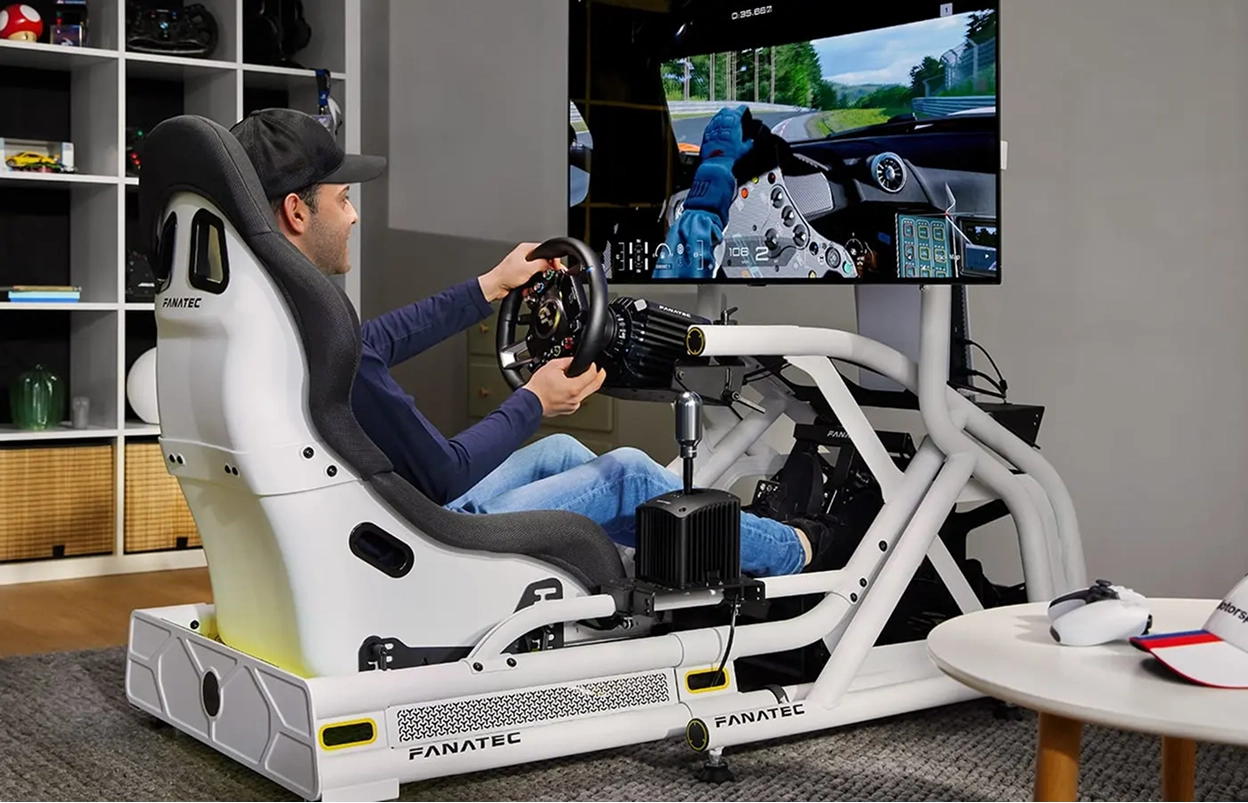
Simulators Buyer's Guide
New to Racing Sims? Read our buyer's guide to find out everything you need to know from Direct Drive to Motion Systems.
Simulators Buyers GuideWhy Buy from Scan?
Expert Knowledge
Deep expertise in high-performance PCs and gaming peripherals
UK-Based Support
Local support team and fast UK delivery options
Pro Trusted
Trusted by esports professionals and sim racing enthusiasts
Custom Builds
Bespoke simulator configurations with 3XS Systems
FAQs
A racing simulator (racing sim) is a gaming setup designed to replicate real-world driving as accurately as possible. Racing sims focus on realistic physics, force feedback, braking, tyre grip and track conditions to deliver an authentic motorsport experience at home.
Sim racing setups range from basic wheel-and-pedal combos to fully immersive rigs with direct drive wheels, load cell pedals, motion platforms, and VR. They’re used by beginners who want to experience the thrill of racing at home, as well as by professional drivers for practice and training. Whether you’re aiming for competitive online racing or realistic solo practice, a simulator offers an unparalleled driving experience that goes beyond traditional gaming.
While some racing simulators are available on consoles, a gaming PC provides the best performance and flexibility for serious sim racing. High-end racing titles often require powerful CPUs and GPUs to deliver smooth frame rates, realistic graphics, and accurate physics, especially when using advanced setups like triple monitors, VR headsets, or high-resolution settings.
A gaming PC also allows for easier upgrades as technology advances, whether that’s a faster GPU for new games, more RAM for smoother performance, or extra storage for multiple racing titles. For rigs with direct drive wheels, load cell pedals, or motion platforms, a PC ensures responsive input, realistic force feedback, and an immersive experience that consoles can struggle to match.
For a truly immersive sim racing experience, you’ll need more than just a wheel and pedals. A high-performance gaming PC ensures smooth frame rates and realistic graphics, especially when running triple monitors or VR.
A direct drive wheel base delivers powerful, detailed force feedback, while load cell or hydraulic pedals provide realistic braking feel. A dedicated sim racing cockpit or aluminium profile rig keeps everything stable under heavy braking and steering forces.
To enhance immersion further, many drivers add triple monitors or an ultrawide display for improved field of view, VR for full cockpit presence, a sequential shifter or handbrake for rally and drifting, and even motion platforms or bass shakers to simulate road texture and car movement.
The result is a setup that closely replicates real-world motorsport, ideal for competitive racers and enthusiasts looking for maximum realism.
The best racing simulator depends on your preference:
- iRacing – Extremely competitive online racing with laser-scanned tracks.
- Assetto Corsa – Popular for GT racing, physics realism, and modding.
- F1 25 – Official Formula 1 experience with licensed tracks and drivers.
Each offers different levels of realism, licensing and multiplayer focus.
Yes. Many racing simulators support VR headsets, providing full cockpit immersion and natural depth perception. A powerful gaming PC is recommended for smooth VR performance.
Force feedback is a technology in racing wheels that simulates the physical forces you would feel when driving a real car. It allows you to feel tyre grip, kerb vibrations, understeer, oversteer and changes in road surface through the steering wheel. Strong, detailed force feedback improves immersion and helps drivers react more accurately to loss of traction, making it essential for competitive sim racing.
A direct drive wheel is a type of racing wheel where the steering wheel is mounted directly onto the motor shaft. This design eliminates belts or gears, allowing the motor to deliver stronger, smoother, and more precise force feedback.
Direct drive wheels provide realistic steering feel, letting you sense tyre grip, understeer, oversteer, and road surface changes with greater accuracy than belt- or gear-driven wheels. They are often used by serious sim racers and professionals because the detailed feedback improves control, lap times, and immersion.
Triple monitors give a wide, uninterrupted field of view and allow for high frame rates, making it easier to see the track and surrounding cars. VR offers full cockpit immersion with natural depth perception and realistic scale, but requires a powerful PC for smooth performance. Many sim racers use a combination depending on preference, space, and budget.
A motion platform simulates the movement of a real car, including acceleration, braking, and cornering forces. By physically tilting or vibrating your cockpit, it adds a new layer of realism, helping you feel weight transfer and road texture. Motion platforms are especially popular for high-end rigs and serious sim racers seeking maximum immersion.
Space requirements vary depending on your setup. A basic wheel and pedal setup can fit on a desk, while a full sim racing cockpit with direct drive wheel, pedals, and triple monitors usually needs a dedicated 2–3 m² area. Motion platforms and larger rigs require extra clearance for safety and movement, so it’s important to measure your room before investing in a high-end setup.
Degrees of freedom (DOF) describe the ways a motion platform can move to replicate real-world car sensations. Each “degree” represents a type of movement:
- 1–3 DOF: Pitch (tilt forward/back), roll (tilt sideways), heave (vertical movement).
- 4–6 DOF: Adds surge (move forward/back), sway (side to side), and yaw (rotation).
More degrees of freedom mean a more realistic, immersive experience, allowing you to feel acceleration, braking, cornering forces, and road texture more accurately. High-end rigs with 6 DOF are typically used by professional drivers and sim racing enthusiasts.