CONTENT HUB
SCAN AI AI PROJECT PLANNING PART 4 OF 7 - MODEL DEVELOPMENT
The previous part of this guide focused on data preparation - a very important stage, as the quality of your data will directly impact the effectiveness and integrity of the next stage - model development. Model development is where you’ll first apply your prepared datasets, in small batches, to test, tweak and test again in order to identify a successful outcome you want to scale and train into a fully-fledged AI model.
Don't start from scratch
Chances are your AI project isn’t unique - even if the outcome is specific to your organisation, it is highly likely someone in your or a similar industry has applied the same logic. Utilising optimised foundation models (FMs) saves time and effort when building an AI pipeline, and an increasing variety of software solutions are removing the need for much of the subsequent development work. A prime example is the NVIDIA AI Enterprise (NVAIE) platform, which features in excess of 30 distinct and interlinked pre-trained frameworks, optimised for NVIDIA GPUs, designed for end-to-end implementation of AI projects such as medical imaging, autonomous vehicles, avatars, drug discovery, robotics, generative AI and many more.

Starting with FMs may help advance your project development. These are large scale, general purpose models with text, audio or video inputs that may be connected to project-specific data for further training, using Retrieval Augmented Generation (RAG) and fine-tuning. The NVIDIA AI Enterprise platform hosts a combination of open and closed-source models and enterprise-ready software to accelerate specialist model training. For most companies the cost of developing an FM from scratch is prohibitive and unnecessary, given the wide choice of pre-trained models available and a preference for working on developing AI for business workflows rather than setting up the system. Our team of SCAN AI experts is ready to support you in developing models and allowing you to focus on inference and time to first token.
One area that our consultants may discuss with you is the constant evolution of AI and the new frameworks and toolkits that are announced almost weekly. However, focusing too heavily on using new cutting-edge approaches may lead to a mismatch between what could be achieved and what your organisation is actually looking for. It is important to build AI systems that are backwards and forwards compatible.
What hardware do I need?
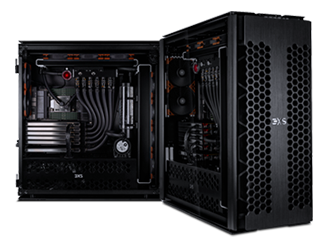
As you'll only be using small batches of data to test models during the development phase, you don't need a huge amount of GPU power to get started. A Scan 3XS AI Development Workstation (or dev box), powered by the latest NVIDIA GPU-accelerators are ideal for the first stage of AI projects, enabling data scientists to develop and debug models. Entry-level workstations are powered by a single NVIDIA GPU, scaling up to six GPUs for maximum performance.
 Learn more
Alternatively, you can avoid hardware expenditure by doing your model development on a cloud service. Scan 3XS Cloud Workstations are GPU-accelerated systems designed from the ground up specifically for AI workloads. Hosted in Scan's UK datacentre, they are based on the same high-quality components as our physical AI Development Workstations. They are available in flexible increments of one week, one month, three months, six months and one year. Access is straight forward from any device, using a secure OpenVPN connection.
 Learn more
Optimising your model
To ensure the optimal performance of training and full-scale production, it is wise to split your data into three sets: training, validation and test. Firstly, training data is used by the model to learn the patterns and features of the data and to make predictions and decisions. Then validation data is used to experiment with different algorithms, architectures and parameters to find the optimal combination for your goal. Finally, test data is used to evaluate your chosen model’s performance on unseen data and estimate how well it will generalise to new situations. You should evaluate your model on various metrics and dimensions, for example accuracy metrics such as precision, recall and F1-score summarised in a confusion matrix, visualisation of the trade-off between sensitivity and specificity using ROC (Receiver Operating Characteristic) curves, and numerical measures of ROC such as AUC (Area Under Curve).
To effectively optimise your model it is likely you’ll need in-depth knowledge, however training your existing teams will take time and new hires in this sector are increasingly sought after and in short supply. It is also worth considering orchestration platforms that help visualise and understand the status of your AI workflows and any issues that may be occurring - to minimise their impact and avoid repeating them. To this end many organisations that cannot make these investments in breadth and depth of talent themselves are partnering with experts in the field - NVIDIA Deep Learning Institute (DLI) courses offer hands-on technical experience, whilst data science consultancy services can help your teams ensure their chosen model is ready for scaling, minimising delays and false starts when you begin full production training.
Read our 7 part AI Project Planning Guide
- Part 1 - Where do I start?
- Part 2 - Setting Expectations
- Part 3 - Data Preparation
- Part 4 - Model Development
- Part 5 - Model Training
- Part 6 - Model Integration
- Part 7 - Governance