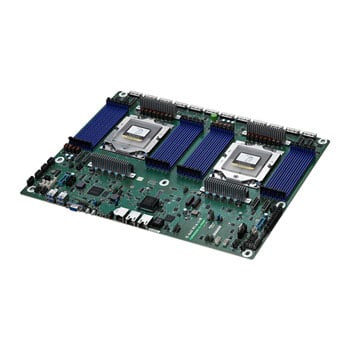

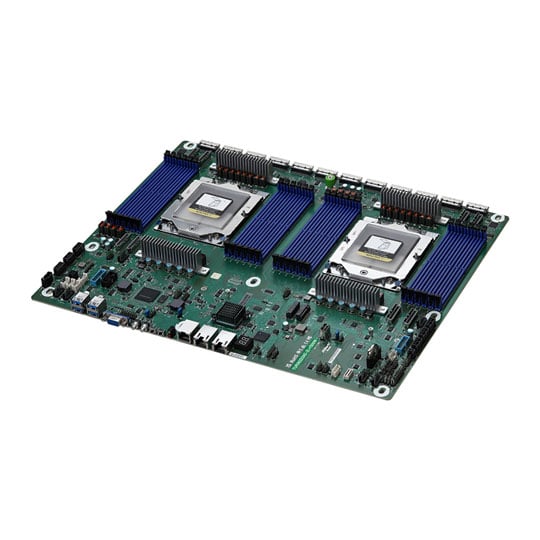
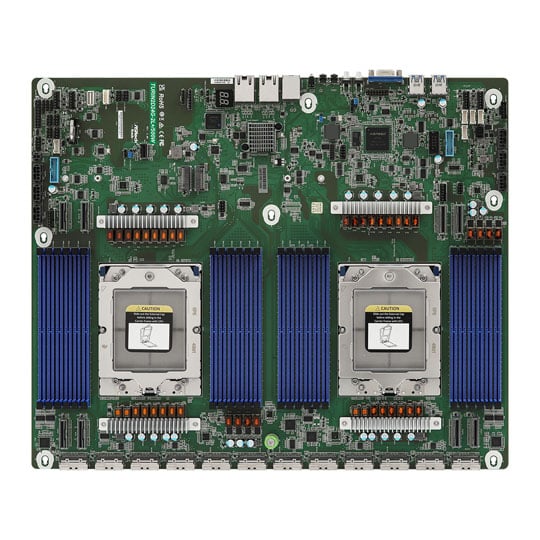
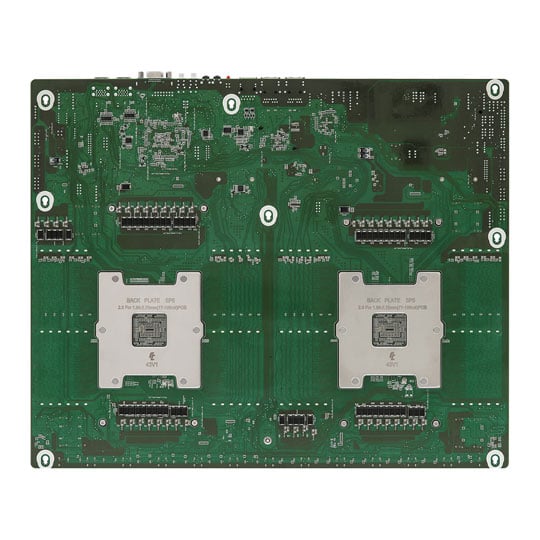


Asrock Rack TURIN2D24G-2L+/500W AMD EPYC 9004 & 9005 Series Motherboard with Full MCIO Expansion
ASRock Rack TURIN2D24G-2L+/500W AMD EPYC 9004/9005 Series Motherboard, 2x SP5, DDR5, 20x MCIO Gen5/CXL, GbE, Proprietary
Email me when the availability or price changes
Suggested Alternatives
 Gigabyte MZ73-LM1 Server BoardGigabyte MZ73-LM1 Server Board
LN146407
No customer review
Gigabyte MZ73-LM1 Server BoardGigabyte MZ73-LM1 Server Board
LN146407
No customer reviewKey Specifications
- Gigabyte MZ73-LM1 Server Board
£1,149.98Pre order
TURIN2D24G-2L+/500W Dual SP5 Platform
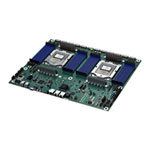
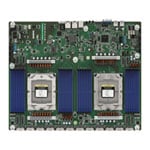
The TURIN2D24G-2L+/500W is a dual-socket SP5 AMD EPYC server motherboard built for very high-power CPUs, dense DDR5 memory, and next-generation PCIe 5.0 and CXL expansion via MCIO. It uses a proprietary 16.93" × 13.78" form factor tailored for OEM chassis, custom backplanes, and high-density rack platforms. Its standout capabilities center on CPU power delivery, memory scale, PCIe/CXL lane exposure, and full server-class management and monitoring.
Ready for AMD EPYC 9005 & 9004 Series Workstation Processors
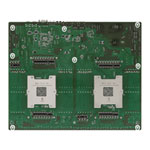
The board supports dual Socket SP5 (LGA 6096), enabling two AMD EPYC 9005, 9004 (including models with AMD 3D V-Cache), and 97x4 series processors on a single platform. Support for EPYC 9005 series processors requires an appropriate BIOS version to ensure compatibility with newer CPU revisions. A defining feature is support for up to 500 W total thermal design power, positioning the platform for high-core-count and high-frequency EPYC configurations intended for sustained, compute-dense operation. The System-on-Chip design of AMD EPYC processors removes the need for an external chipset, consolidating I/O, memory controllers, and storage directly onto the CPU and reducing platform complexity.
High-Density DDR5 Expansion
The motherboard provides 12+12 DIMM slots (24 total), arranged in a 1DPC (one DIMM per channel) topology around the two CPU sockets to preserve signal integrity and consistent channel bandwidth. It supports DDR5 288-pin RDIMM and RDIMM-3DS modules, allowing flexibility between cost-focused deployments and extreme memory-capacity builds. Maximum supported capacity per DIMM reaches 128 GB using standard 2Rx4 RDIMMs and up to 256 GB using RDIMM-3DS modules, enabling multi-terabyte memory configurations on a single board.
PCIe 5.0, CXL and Storage Connectivity
Rather than relying on traditional PCIe slots, the board exposes its high-speed I/O through MCIO connectors and M.2, targeting dense server enclosures and modular expansion designs. Two M.2 slots (M2_1 and M2_2) support PCIe 3.0 x4 or SATA 6 Gb/s devices in 22110 or 2280 form factors, with one slot electrically connected to each CPU. For large-scale expansion, the platform provides a substantial MCIO layout per processor. Each CPU exposes six MCIO connectors supporting PCIe 5.0 x8 with CXL capability, alongside additional MCIO ports that can be configured either as PCIe 5.0 x8 or as eight SATA 6 Gb/s lanes per connector. When populated with AMD EPYC 9004 or 97x4 processors, CXL operates at version 1.1, with newer CPU generations enabling later CXL revisions where supported. Using EPYC’s integrated storage controllers, the board can expose up to 32 SATA 6 Gb/s ports through MCIO, supplemented by an ASM1061 controller that adds two additional SATA 6 Gb/s ports via the M.2 interface, for a total of up to 34 SATA connections.
PCIe Lane Bifurcation and Expansion Flexibility
The MCIO-based design enables extensive PCIe lane bifurcation, allowing x8 links to be subdivided downstream into multiple narrower connections depending on the attached backplane or riser design. This supports high-density NVMe layouts, accelerator clusters, or mixed-function expansion where a single MCIO port can fan out to multiple PCIe endpoints. Certain MCIO connectors operate with role-specific constraints. For example, selected MCIO ports are limited to PCIe-only operation when both CPU sockets are populated, reflecting lane allocation rules within the dual-socket EPYC topology. These behaviors are managed at the platform and BIOS level, ensuring predictable lane routing for OEM and system integrator designs.
Networking, Management and I/O
Onboard networking is provided by an Intel i350 controller delivering two 1 GbE RJ45 ports, suitable for management networks, service planes, or low-latency control traffic. A dedicated Realtek RTL8211F PHY connects directly to the ASPEED BMC, providing an isolated IPMI management LAN for remote access and monitoring. The ASPEED AST2600 controller also supplies VGA output for local console access and underpins full remote KVM, sensor telemetry, and power control through IPMI.
Rear I/O and Internal Connectivity
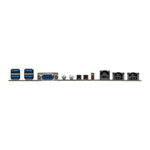
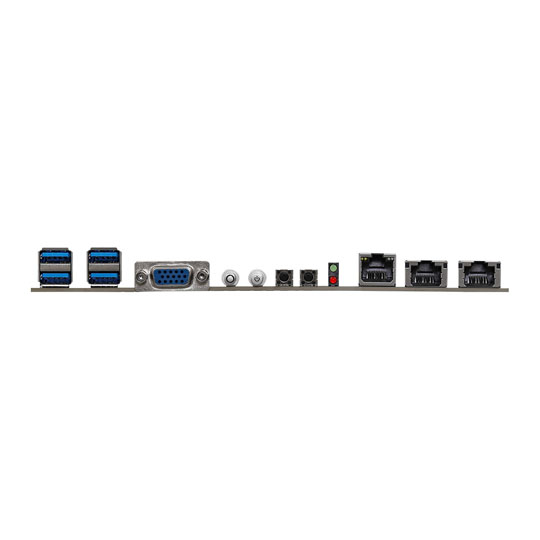
Rear I/O includes a DB15 VGA port, four USB 3.2 Gen1 Type-A ports, and server-focused controls including UID, power, reset, NMI buttons, and system and drive activity LEDs. Internally, the board offers extensive headers for chassis and backplane integration, including USB 3.2 Gen1 headers, COM, VGA, TPM (SPI), SGPIO, SMBus, PMBus, IPMB, system panel, auxiliary panel, fan headers, and PSU signaling connections. Power delivery is handled through multiple Micro-Fit and Micro-Hi connectors suited for high-current server power supplies.
Management, Monitoring and Diagnostics
The platform uses an AMI UEFI BIOS stored in a 256 Mb (32 MB) SPI flash, supporting ASRock Rack Instant Flash, ACPI 6.4 wake-up events, and SMBIOS 3.5 or later for compatibility with modern operating systems and hypervisors. Diagnostic indicators include a standby power LED, an 80-port debug LED, six fan-fail LEDs, and a BMC heartbeat LED, enabling rapid fault identification during deployment and servicing.
• Proprietary dual-socket server motherboard measuring 16.93" × 13.78", designed for OEM chassis and backplane-based systems.
• Supports two Socket SP5 (LGA 6096) processors with AMD EPYC 9005, 9004 (including 3D V-Cache), and 97x4 series CPUs.
• Rated for processor thermal design power up to 500 W across the dual-socket platform.
• System-on-Chip architecture places memory, I/O, and storage controllers directly on the CPUs with no external chipset.
• Provides 12+12 DDR5 DIMM slots in a 1DPC topology for consistent channel bandwidth.
• Supports DDR5 288-pin RDIMM and RDIMM-3DS memory modules.
• Maximum memory capacity per DIMM is 128 GB for RDIMM and 256 GB for RDIMM-3DS.
• Supports DDR5 memory speeds up to 6400 MHz at 1.1 V.
• Exposes PCIe expansion exclusively through MCIO connectors rather than onboard PCIe slots.
• Each CPU provides six MCIO connectors supporting PCIe 5.0 x8 with CXL capability.
• Additional MCIO connectors per CPU can be configured as PCIe 5.0 x8 or as eight SATA 6 Gb/s lanes.
• Selected MCIO connectors operate as PCIe-only when both CPU sockets are populated.
• Supports CXL 1.1 when used with EPYC 9004 and 97x4 processors.
• Includes two M.2 slots supporting PCIe 3.0 x4 or SATA 6 Gb/s in 22110 or 2280 form factors.
• Integrated CPU storage controllers support up to 32 SATA 6 Gb/s ports via MCIO.
• An onboard ASM1061 controller adds two additional SATA 6 Gb/s ports through the M.2 interface, enabling up to 34 SATA connections total.
• Provides two 1 GbE RJ45 ports driven by an onboard Ethernet controller for system networking.
• Includes a dedicated IPMI management LAN port connected to the onboard BMC.
• Uses an ASPEED AST2600 BMC to deliver remote KVM, power control, and hardware monitoring.
• Rear I/O includes one VGA port, four USB 3.2 Gen1 Type-A ports, and server control buttons and LEDs.
• Supports AMI UEFI BIOS stored in a 256 Mb SPI flash with ACPI 6.4 and SMBIOS 3.5 or later.
• Monitors CPU, motherboard, and card-side temperatures along with multiple voltage rails.
• Provides six fan headers with tachometer feedback and automatic fan speed control.
• Includes onboard diagnostic LEDs for standby power, POST status, fan failure, and BMC heartbeat.