Development is the initial stage of any AI journey, prior to training and inferencing. Hardware selection is crucial to get right as mistakes made at the development phase can be very costly further down the line in terms of both expenditure and time. This guide covers the various AI development hardware options, explaining their differences and suitability for different AI projects.
Starting your AI Project
Although model development is the first of the three classic stages of an AI project, this phase is always preceded by a number of equally critical steps, including high-level planning, project scope setting and data preparation, as illustrated below.
Problem Statement
Project scope and high level ROI
Data Preparation
Classification, cleaning and structure
Model Development
Education and resource allocation
Model Training
Optimisation and scaling
Model Integration
Inferencing and deployment
Governance
Maintenance and compliance
It may not be immediately obvious, but ensuring your project scope is realistic and achievable has a large impact on what AI development hardware you'll ultimately require. Similarly, undertaking adequate data preparation, including classification, structuring and cleansing of data, ensures you know the precise size of datasets you'll be dealing with - thus providing an indication for GPU sizing, memory capacity and storage choices. Perhaps most crucially, data size also impacts the ability to scale your model as you iterate numerous options and evaluate outcomes. This data preparation stage can be up to as much as 60% of the entire time of your entire AI project, indicating how important it is to get it right. You can learn more about these crucial pre-development stages by reading our A-Z of AI White Paper.
AI Model Development
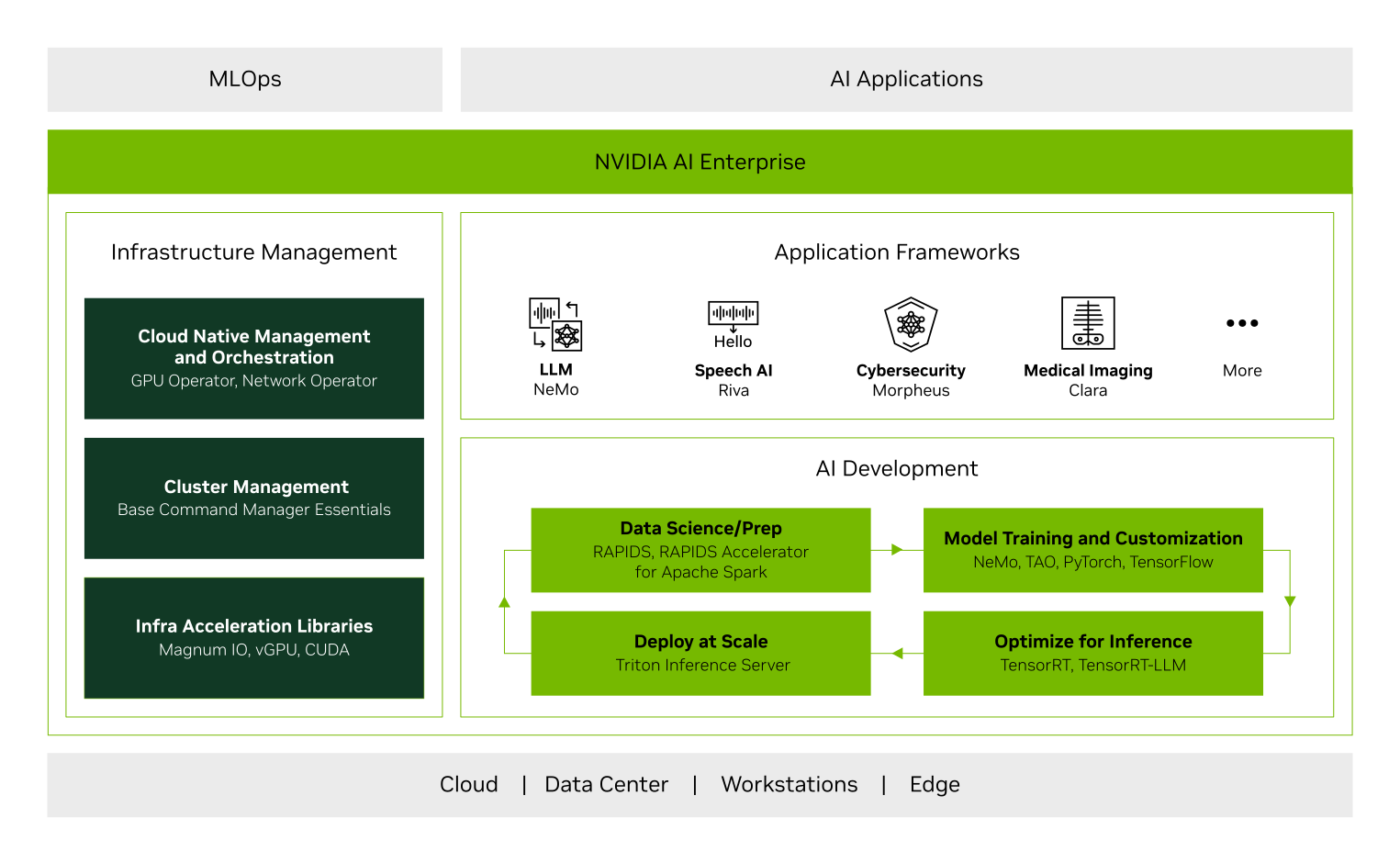
When it comes to using your prepared data in model development, chances are your project isn't unique, so there may well be pre-trained frameworks or optimised foundation models (FMs). These save time and effort when building an AI pipeline, and removing the need for much of the subsequent development work. A prime example is NVIDIA AI Enterprise (NVAIE), which features in excess of 30 distinct and interlinked pre-trained frameworks, optimised for NVIDIA GPUs, designed for end-to-end implementation of AI projects such as medical imaging, autonomous vehicles, avatars, drug discovery, robotics, generative AI and many more.
Understanding the frameworks or FMs available to you may also have a significant impact on your AI development platform choice, as it may dictate a minimum GPU memory size or level of performance required to complete this phase within a given timeframe. When it comes to model size, some FMs may already number into the several billion-parameter space, before you start fine-tuning them into your own tailored (often even larger) model. It is therefore key to understand the relative size of models, how they might scale and the GPU hardware that will be capable of handling this. Just for context, between the 1950s and to 2018, AI model size grew by seven orders of magnitude (from 000's to 30M) – yet from 2018 to 2022 alone, it has grown another four orders of magnitude (from 30M to 20B). Today 400B parameter models are not uncommon and ChatGPT-4 is rumoured to have 1.8T parameters.
AI model categories by typical use case, parameter count, dataset size and GPU requirements.
It is worth clarifying that this table is for guidance only - absolute size (in GB) of any model is determined by number of parameters and the size of each parameter. Similarly, there will be small agentic AI models if their function is very focused and there will be very large LLMs if translation of many languages is the goal. It is also worth pointing out that the dataset size mentioned is the likely final size, so you need to consider capacity for numerous versions and many many iterations before reaching the final model. You can find more in-depth information about model development by reading our A-Z of AI White Paper.
AI Hardware
The following development options are compared and discussed in light of the model sizes above, offering recommendations and advice about the most suitable option for various scenarios. However, as previously stated thorough planning and scoping phases will lead to much more accurate provisional model sizes and better insight into hardware choice.
Traditional AI workstations are built around the industry-norm of an x86 CPU (either AMD or Intel) plus one or more NVIDIA RTX GPUs connected via the PCIe bus. The major benefit of this approach is that as a well-established system architecture over decades, such systems are extremely cost-effective and very easy to expand with more powerful processors, memory, storage and networking as your needs grow.
The downsides are that the CPU and GPU have separate pools of memory and that NVIDIA RTX GPUs are currently limited to 96GB of memory, so require multiple cards to run generative AI and reasoning AI models effectively. A new approach, using system-on-chip (SoC) provides a single CPU/GPU resource connected to a large combined memory pool.
Click the tabs below to explore these options, or of course you can contact our AI team for more information or advice.
NVIDIA DGX Spark
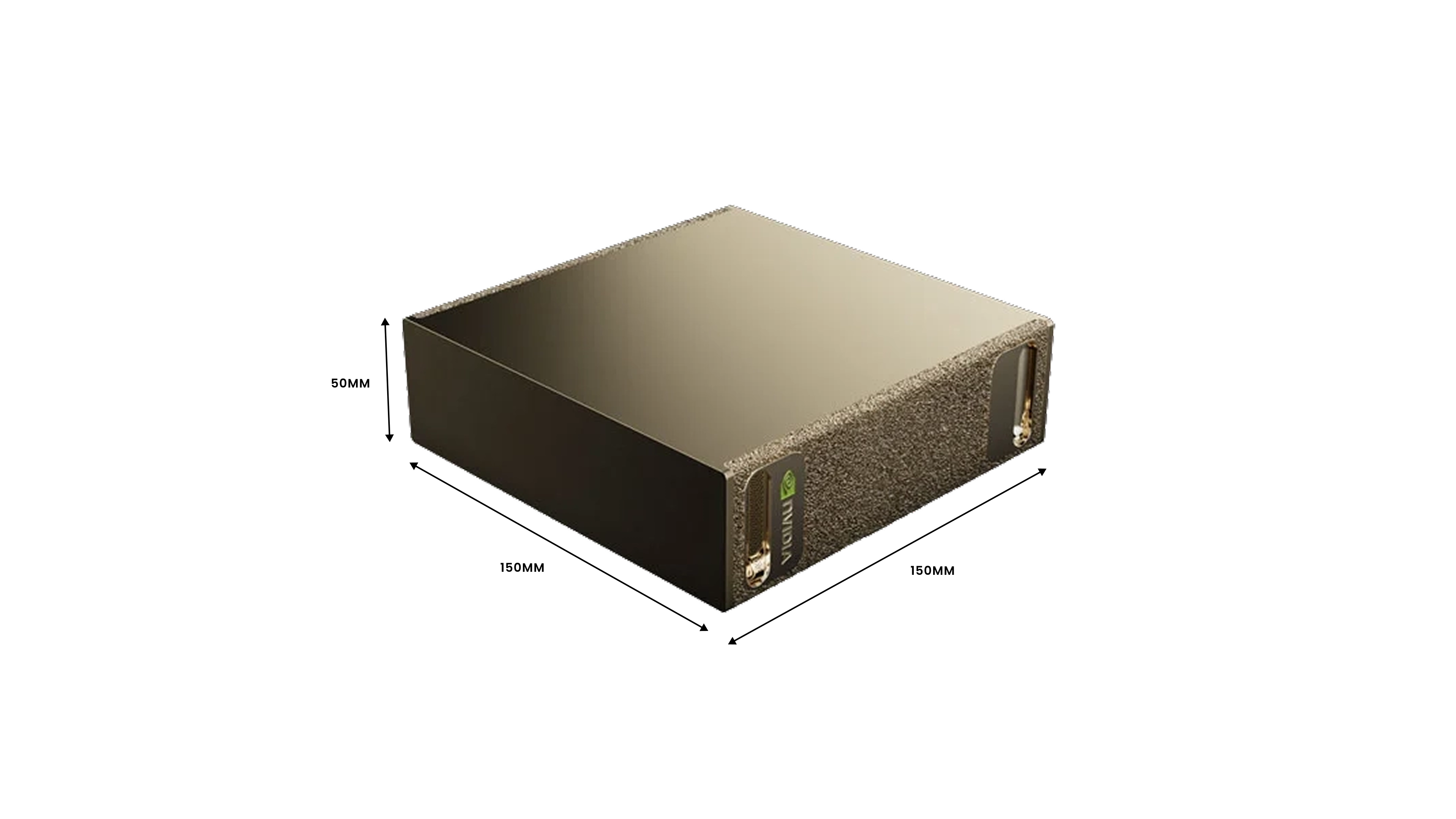
The DGX Spark is NVIDIA's latest appliance for developers looking for a desktop solution to develop and fine-tune generative AI and reasoning AI models. These are particularly challenging workloads as they have a large memory footprint, so are too large to run on many existing GPUs. The DGX Spark has been built from the ground-up to provide a single large memory pool. It achieves this by replacing the old discrete CPU and GPU paradigm with a SoC, combining CPU and GPU cores together in a single unit, making the unit very compact despite its considerable performance.
Architecture
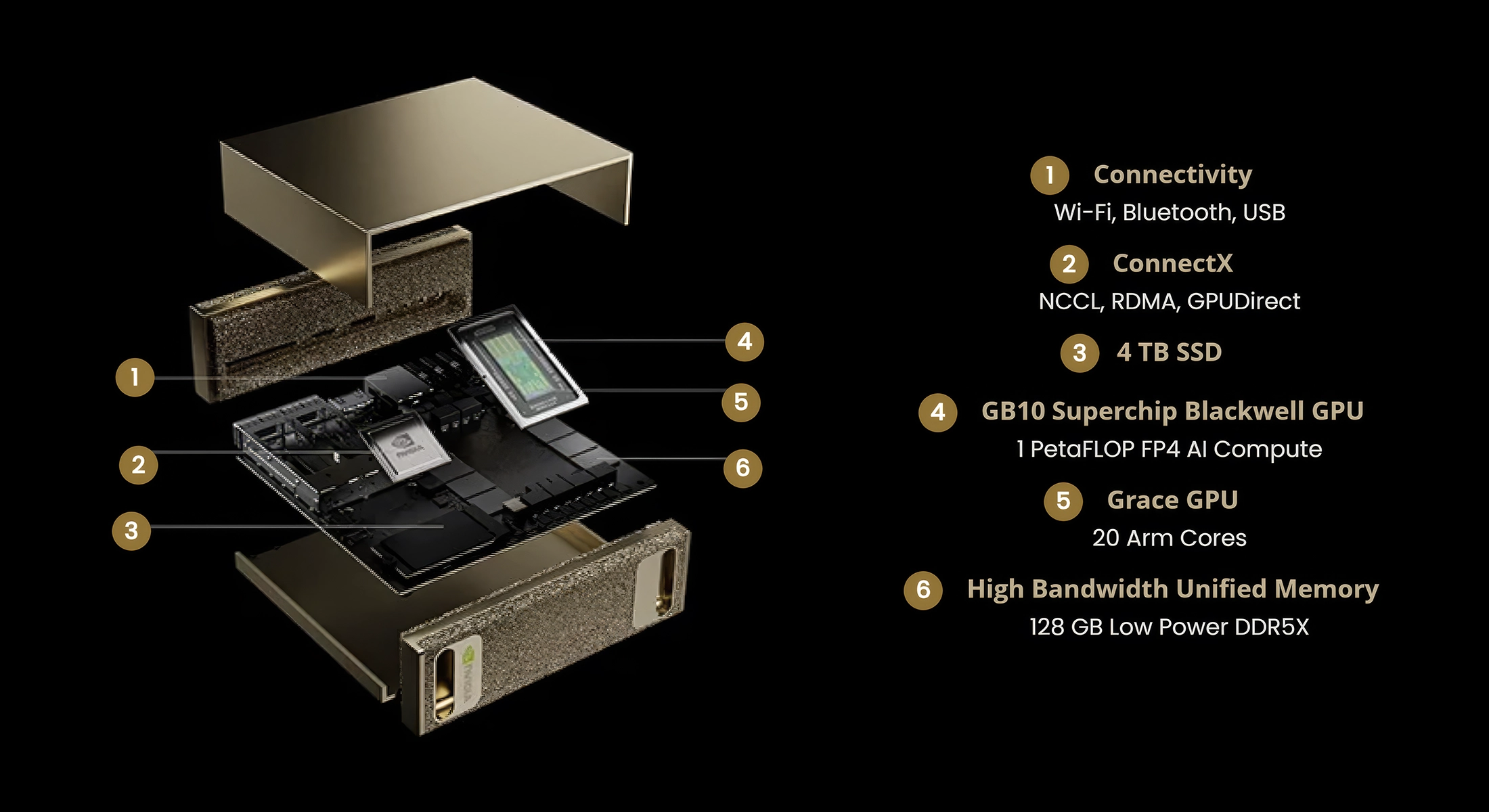
Known as the GB10 Grace Blackwell Superchip, this SoC comprises a Blackwell GPU and 20 Arm CPU cores, sharing a unified 128GB of memory. The GPU element of the SoC is equipped with the latest 5th gen Tensor cores, which are optimised for performing FP4 calculations, the most commonly used precision level for generative AI and reasoning AI models, while the CPU element has ten Cortex X925 and ten Cortex A725 cores.
The SoC is supported by 4TB of NVMe SSD storage, alongside a 10GbE Ethernet port, ConnectX-7 SmartNIC and WiFi 7 for ingesting data. Just like a typical desktop PC, the DGX Spark has a HDMI port to connect a monitor, plus four USB Type C ports to connect peripherals. Furthermore, three DGX Spark units can also be clustered using a special LinkX cable, effectively creating a combined 384GB memory pool for running extremely larger models.
The DGX Spark runs DGX OS, which is a NVIDIA-customised version of Ubuntu Linux. This enables developers to unleash the full potential of their DGX Spark with a proven software platform built around a complete AI software stack including access to NVIDIA NIM microservices, Blueprints and AI Enterprise. This is of course the same software stack as other NVIDIA AI appliances, making it easy to transfer your newly-developed AI model onto more powerful MGX, HGX or DGX systems, whether they're in your own datacentre or in the cloud.
3XS AI Development Laptop
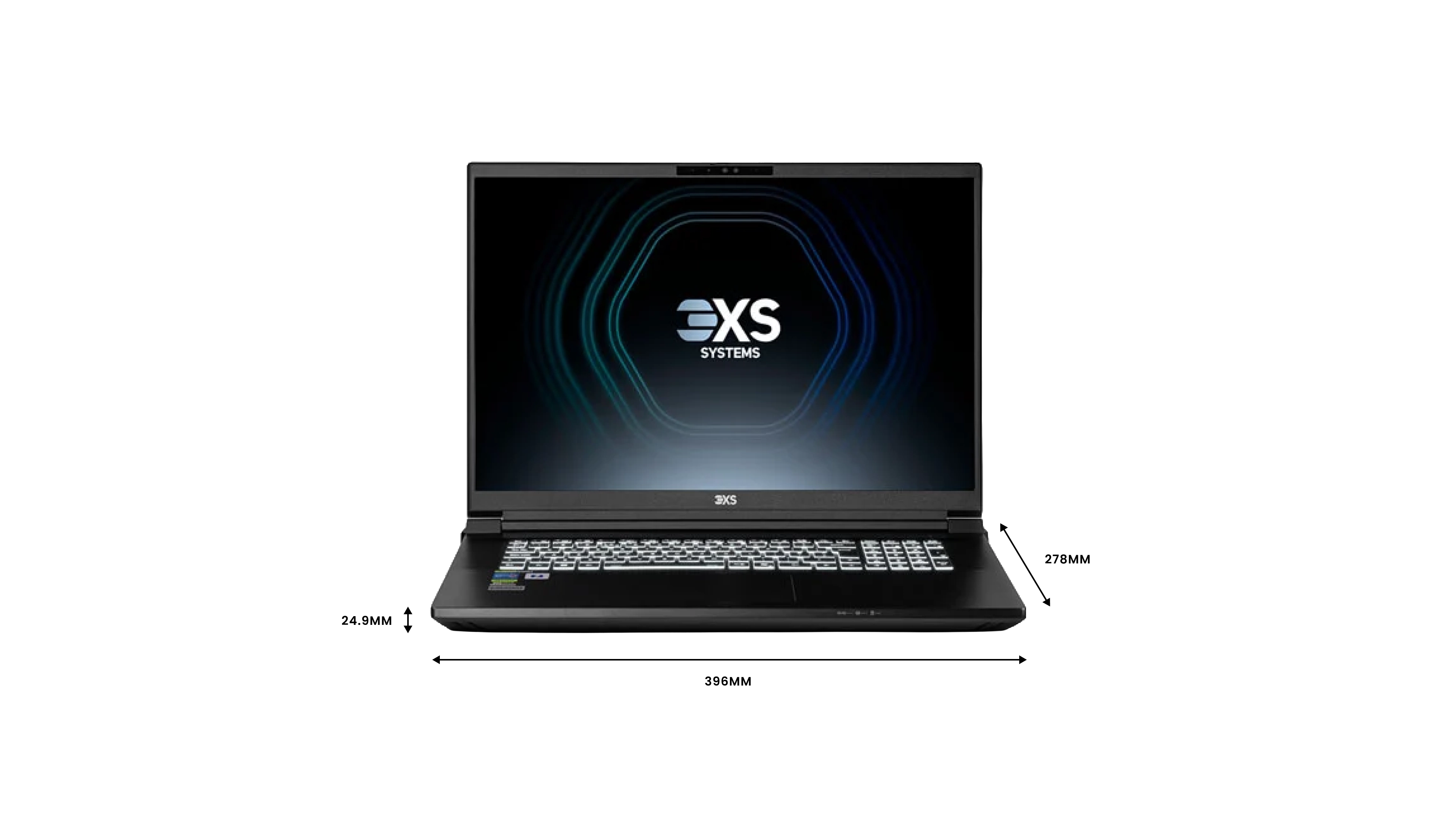
3XS AI Development Laptops are custom-built for flexibility whilst maintaining the ability to effectively develop and debug your AI projects. Featuring an 18” QHD+ screen, an x86 CPU combined with the latest NVIDIA Blackwell GPU enabling you to identify the MVP (Minimum Viable Product). This mobile platform is ideal to learn valuable insights from failed models before rolling out your code to a compatible NVIDIA training system, such as an MGX, HGX or DGX server.
3XS Systems has been hand crafting PCs, workstations and servers for more than 30 years. We pioneered the AI dev box back in 2016, so we have a huge amount of experience in building highly reliable systems that deliver the most performance for your budget. Here are the key reasons to trust a 3XS AI Development Laptop.
handshake
NVIDIA Elite Partner
Scan has been an accredited NVIDIA Elite Partner since 2017, awarded for our expertise in the areas of deep learning and AI.
manufacturing
AI Optimised
Our in-house team includes data scientists who optimise the configuration and software stack of each system for AI workloads.
verified
Trusted by you
Scan 3XS Systems AI dev boxes are trusted by organisations including the NHS, University of Liverpool and University of Strathclyde.
counter_7
7 Days Support
Our technical support engineers are available seven days a week to help with any queries.
license
3 Years Warranty
3XS Systems include a three-year warranty, so if anything goes faulty we'll repair or replace it.
Architecture
The specifications feature a 24GB NVIDIA GeForce RTX 5090 GPU with an Intel Core Ultra 9 275HX CPU, plus up to 64GB of Corsair Vengeance 4,400MHz DDR5 system memory. An ultra-fast 2TB SSD is provided for the OS, caching and datasets.
GEFORCE RTX 5090
Architecture
Blackwell
CUDA Cores
10,496
Tensor Cores
328 5th gen
RT Cores
82 4th gen
Memory
24GB GDDR7
ECC Memory
✖
Memory Controller
256-bit
NVLink
✖
TDP
95W
The systems are soak tested with deep learning workloads and pre-installed with the latest Ubuntu operating system plus a custom software stack built on NVIDIA CUDA that includes Docker-CE, Nvidia-Docker2 and GPU-optimised libraries. Optional access to NVAIE for frameworks and applications is also available.
3XS AI Development Workstation
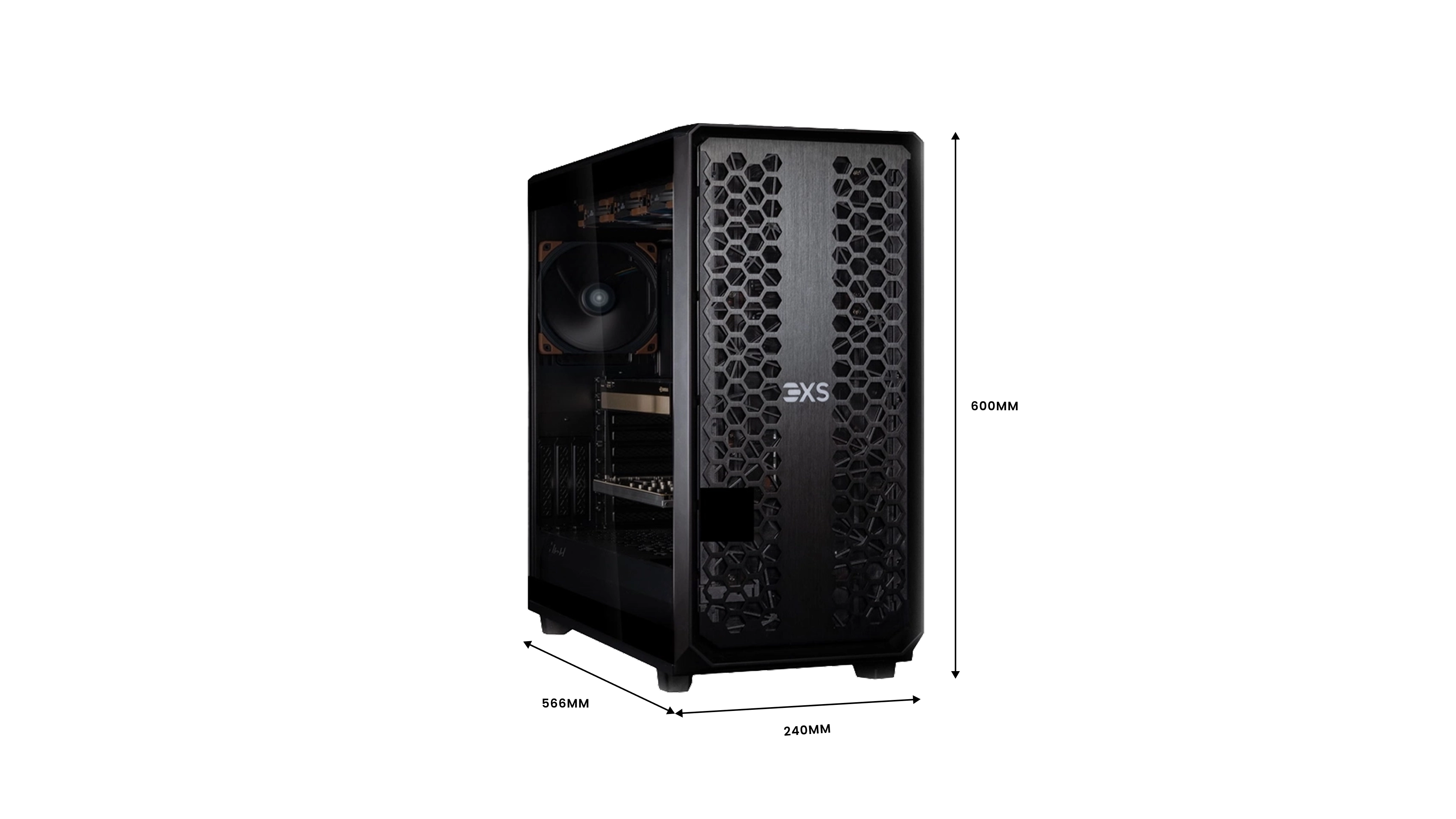
3XS AI Development Workstations are custom-built to allow maximum tailoring and scaling for your models. Featuring multiple NVIDIA RTX PRO or GeForce RTX GPUs, they offer the ultimate in cost-effective AI model development, ready for rolling out your code to a compatible NVIDIA training system, such as an MGX, HGX or DGX server.
3XS Systems has been hand crafting PCs, workstations and servers for more than 30 years. We pioneered the AI dev box back in 2016, so we have a huge amount of experience in building highly reliable systems that deliver the most performance for your budget. Here are the key reasons to trust a 3XS AI Development Workstation.
handshake
NVIDIA Elite Partner
Scan has been an accredited NVIDIA Elite Partner since 2017, awarded for our expertise in the areas of deep learning and AI.
manufacturing
AI Optimised
Our in-house team includes data scientists who optimise the configuration and software stack of each system for AI workloads.
volume_off
Whisper Quiet
Only hear what matters – select configurations are watercooled and so are much quieter than air-cooled PCs.
verified
Trusted by you
Scan 3XS Systems AI dev boxes are trusted by organisations including the NHS, University of Liverpool and University of Strathclyde.
counter_7
7 Days Support
Our technical support engineers are available seven days a week to help with any queries.
license
3 Years Warranty
3XS Systems include a three-year warranty, so if anything goes faulty we'll repair or replace it.
Architecture
The flexible multi-GPU configuration supports either NVIDIA RTX PRO GPUs for maximum performance or consumer-grade NVIDIA GeForce GPUs for value for money. A simple comparison is detailed in the table below, but for further information please read our NVIDIA Workstation GPU Buyers Guide or our NVIDIA GeForce GPU Buyers Guide.
RTX PRO 6000 Blackwell
RTX PRO 6000 Blackwell Max-Q
RTX PRO 5000 Blackwell
RTX PRO 4500 Blackwell
RTX PRO 4000 Blackwell
GeForce RTX 5090
GeForce RTX 5080
Architecture
Blackwell
Blackwell
Blackwell
Blackwell
Blackwell
Blackwell
Blackwell
CUDA Cores
24,064
24,064
12,800
10,496
8960
21,760
10,752
Tensor Cores
752 5th gen
752 5th gen
400 5th gen
328 5th gen
280 5th gen
680 5th gen
336 5th gen
RT Cores
188 4th gen
188 4th gen
100 4th gen
82 4th gen
70 4th gen
170 4th gen
84 4th gen
Memory
96GB GDDR7
96GB GDDR7
48GB GDDR7
32GB GDDR7
24GB GDDR7
32GB GDDR7
16GB GDDR7
ECC Memory
✔
✔
✔
✔
✔
✖
✖
Memory Controller
512-bit
512-bit
384-bit
256-bit
192-bit
512-bit
256-bit
NVLink
✖
✖
✖
✖
✖
✖
✖
MIG
4 instances
4 instances
2 instances
✖
✖
✖
✖
TDP
600W
300W
300W
200W
140W
575W
360W
For maximum customisation, these GPUs can be combined with either AMD Ryzen 9 or Threadripper CPUs, or Intel Core Ultra 9 or Xeon-W CPUs. We also offer special watercooled workstations with up to eight GPUs, providing extremely high compute performance and a vast combined memory pool. You can learn more about AMD and Intel CPUs by reading our AMD Desktop CPU Buyers Guide or our Intel Desktop CPU Buyers Guide. The systems support up to 512GB system memory and multiple SSDs. Networking is 10GbE as standard, with options for NVIDIA ConnectX SmartNICs at Ethernet or InfiniBand Speeds of up to 400Gb/s.
The systems are soak tested with deep learning workloads and pre-installed with the latest Ubuntu operating system plus a custom software stack built on NVIDIA CUDA that includes Docker-CE, Nvidia-Docker2 and GPU-optimised libraries. They are Proxmox-ready and feature optional access to NVAIE for frameworks and applications is also available.
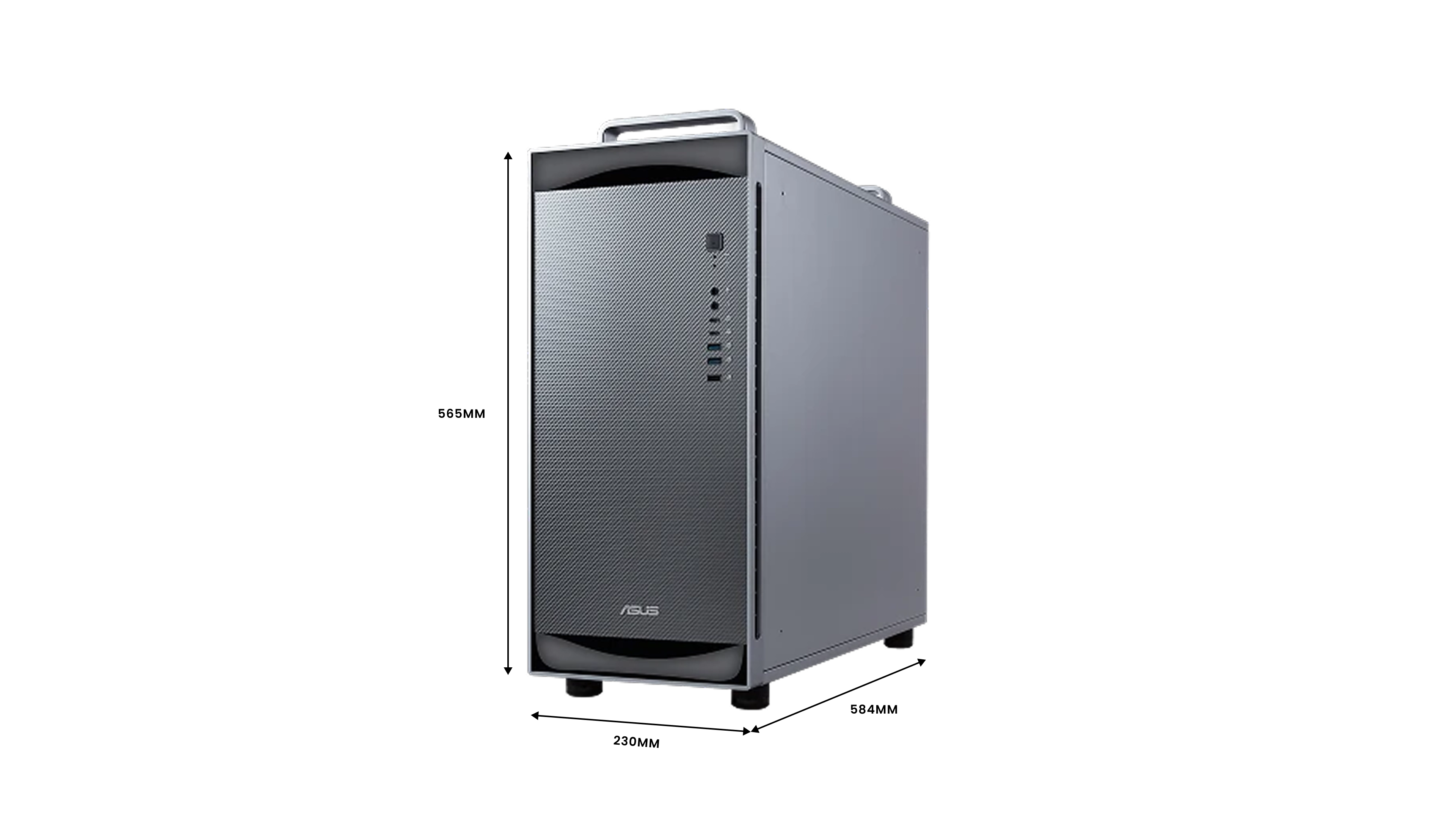
The DGX Station GB300 is NVIDIA's latest datacentre-at-the desktop scale appliance for developers looking for a solution to develop and fine-tune the largest generative, agentic or physical AI models. These are particularly challenging workloads as they have the largest memory footprint, so are too large to run on most existing GPUs. The DGX Station GB300 has been designed from the ground-up to provide a single extremely large memory pool. It achieves this by replacing the old discrete CPU and GPU paradigm with a SoC, combining CPU and GPU cores together in a single unit, linked to a coherent pool of memory.
Architecture
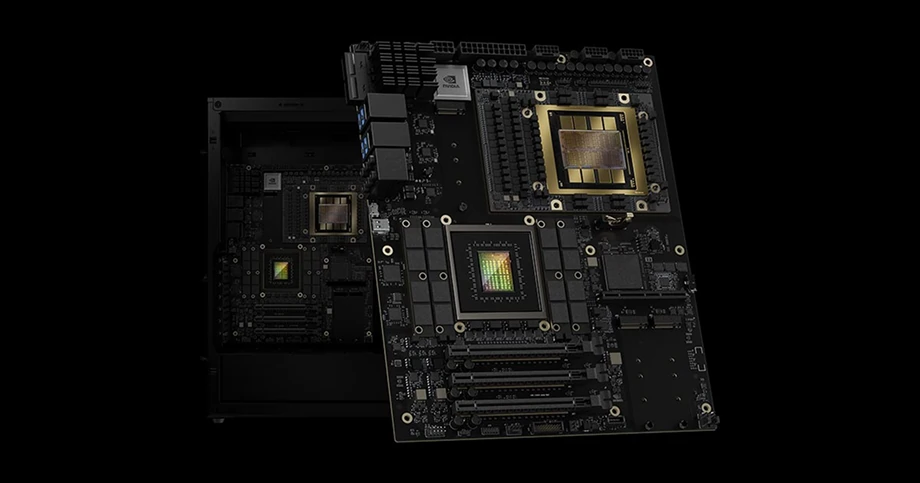
Known as the GB300 Grace Blackwell Superchip, this SoC comprises a Blackwell Ultra GPU and a Grace 72-core Neoverse V2 Arm CPU, sharing a coherent 252GB HBM3e GPU memory and 496GB LPDDR5X system memory, connected via a chip-to-chip link at 900GB/s. The GPU features 5th generation Tensor cores and multi-GPU (MIG) capability where up to seven discreetly containerised instances can be created from the single powerful GPU, making model development very scalable, flexible and secure. Standard networking includes an NVIDIA ConnectX-8 SuperNIC with Ethernet or InfiniBand speeds of up to 800Gb/s.
The DGX Station GB300 runs DGX OS, which is a NVIDIA-customised version of Ubuntu Linux. This enables developers to unleash the full potential with a proven software platform built around a complete AI software stack including access to NVIDIA NIM microservices, Blueprints and AI Enterprise. This is of course the same software stack as other NVIDIA AI appliances, making it easy to transfer your newly-developed AI model onto more powerful MGX, HGX or DGX systems, whether they're in your own datacentre or in the cloud. The DGX Station is available from a variety of manufacturers including Asus, MSI and Supermicro from Scan. Unlike the
DGX Spark, the specification of the DGX Station is partially customisable, such as what GPU is used to output to a monitor.
Comparative Performance
When choosing which AI development platform is right for your needs its important to not only look at its raw compute performance (typically measured in TOPS or FLOPS) but also the amount of memory, as this determines how large your AI model can be (typically measured in billions of parameters). This is quite a fundamental shift from a few years ago, when raw compute performance was the most important factor, and is due to the increasing use of LLMs when it comes to developing AI models. The table below compares the performance of the most popular systems.
Summary analysis of AI development systems by performance, memory, cooling and price profile.
System
NVIDIA DGX Spark
2x NVIDIA DGX Spark
3x NVIDIA DGX Spark
3XS AI Laptop
3XS AI Workstations
NVIDIA DGX Station GB300
Analysis
The DGX Spark has a comparatively low FP4 performance of 1,000 TOPS, but has a very large 128GB memory (or 384GB if you cluster three Sparks).
This makes it an attractive choice for cost-effectively developing extremely large AI models.
3XS AI Laptops have a comparatively low FP4 performance of 1,824 TOPS and only 24GB memory.
3XS AI Workstations give you the flexibility to match the spec to your project requirements, with watercooled configurations offering up to eight GPUs for incredible performance and memory capacity.
Depending which GPUs you choose, you can expect superior FP4 performance to the DGX Spark and Station. However, you need to mindful of memory capacity, especially with GeForce RTX GPUs. These were incredibly popular a few years ago, but their limited memory is now becoming a real issue.
The DGX Station GB300 has an outstanding FP4 performance of 20,000 TOPS and huge memory of 748GB.
Combined with the fastest networking, this makes it ideal for the largest parameter AI models.
GPU(s)
1x NVIDIA GB10
2x NVIDIA GB10
3x NVIDIA GB10
1x NVIDIA GeForce RTX 5090
2x NVIDIA GeForce RTX 5090
8x NVIDIA GeForce RTX 5090
2x NVIDIA RTX PRO 6000 Blackwell
8x NVIDIA RTX PRO 6000 Blackwell
1x NVIDIA GB300
Cooling
Air
Air
Air
Air
Air
Water
Air
Water
Air
AI performance (FP4 TOPS)*
1,000
2,000
3,000
3,648
6,704
26,816
8,000
26,808
20,000
GPU memory*
128GB
256GB
384GB
32GB
64GB
256GB
192GB
768GB
748GB
Billions of AI model parameters (FP4)*
200
400
600
38
102
408
307
1,224
1,200
Typical Price
£5,249.00Free delivery on your entire basket
Get it Tomorrow, 05 OctIn stock
£10,649.00Free delivery on your entire basket
Get it Tomorrow, 05 OctIn stock
£16,039.00Free delivery on your entire basket
Get it Tomorrow, 05 OctIn stock
£3,879.98Free delivery on this item
ETA 4-5 weeks
£17,999.99Free delivery on this item
ETA 3-5 days
£74,999.99Free delivery on this item
ETA 10-15 days
£189,999.98Free delivery on this item
ETA 10-15 days
£119,999.99
Pre order
* combined figure for all GPUs
Comparative TCO
Most AI development systems have much higher power consumption than traditional workstations or office PCs so it's also important to think about TCO (Total Cost of Ownership). The table below compares their cost over time, with the TCO calculated after one year and then after three years.
Comparative total cost of ownership for AI development systems.
System
NVIDIA DGX Spark
2x NVIDIA DGX Spark
3x NVIDIA DGX Spark
3XS AI Laptop
3XS AI Workstations
NVIDIA DGX Station GB300
GPU(s)
1x NVIDIA GB10
2x NVIDIA GB10
3x NVIDIA GB10
1x NVIDIA GeForce RTX 5090
2x NVIDIA GeForce RTX 5090
8x NVIDIA GeForce RTX 5090
2x NVIDIA RTX PRO 6000 Blackwell
8x NVIDIA RTX PRO 6000 Blackwell
1x NVIDIA GB300
System Price
£5,249.00Free delivery on your entire basket
Get it Tomorrow, 05 OctIn stock
£10,649.00Free delivery on your entire basket
Get it Tomorrow, 05 OctIn stock
£16,039.00Free delivery on your entire basket
Get it Tomorrow, 05 OctIn stock
£3,879.98Free delivery on this item
ETA 4-5 weeks
£17,999.99Free delivery on this item
ETA 3-5 days
£74,999.99Free delivery on this item
ETA 10-15 days
£189,999.98Free delivery on this item
ETA 10-15 days
£119,999.99
Pre order
Maximum power consumption
240W
480W
720W
330W
2,000W
6,000W
1,500W
6,000W
1,600W
TCO after 1 year*
TBA
TBA
TBA
TBA
TBA
TBA
TBA
TBA
TBA
TCO after 3 years*
TBA
TBA
TBA
TBA
TBA
TBA
TBA
TBA
TBA
* TCO includes system price plus estimated power consumption cost (typified as Mon – Fri at 80% system utilisation). Unit cost of electricity = £0.25 per kWh, as of June 2026.
Which is the best AI workstation?
Thanks to its innovative SoC architecture, the DGX Spark is the only reasonably-priced system that can develop AI models with a large number of parameters, such as generative AI and reasoning AI models. The DGX Spark is not only cost-effective up-front, but has a very low TCO thanks to its frugal power consumption. Being a desktop device, the DGX Spark is also a practical choice for organisations that for policy reasons are unable to upload their data into a cloud service.
3XS AI Workstations are a supremely capable AI development solution. They are available in a wide variety of configurations from just one GPU, to as many as seven GPUs, enabling you to match the spec to your project and budget requirements. This is the best solution if you need to gradually scale, just bear in mind that this comes at the cost of comparatively high TCO, as using multiple GPUs is less power efficient than a single all-powerful SoC.
Like the DGX Spark, the DGX Station GB300 also has an innovative SoC architecture, enabling it to develop AI models at enormous scale and great speed. The DGX Station is not only the best AI workstation for single-users, but also small teams, with up to seven users being able to share access simultaneously.
Finally, a 3XS AI Development Laptop is the only solution that enables you to develop AI models from anywhere - albeit with some quite severe memory limitations. It's therefore advisable to pair a laptop alongside a desktop device or cloud service, so that work needn't stop when you are on the move.
Proof of Concept
Any of these four solutions can be trialed free-of-charge in our proof-of-concept hosted environment. Your trial will involve secure access where you can use a sample of your own data for most realistic insights, and you'll be guided by our expert data scientists to ensure you get the most from your PoC.
Although this guide has been concerned with AI development hardware, we also supply all of these GPU-accelerated systems as virtual systems on our Scan Cloud platform.
Simple, Flexible Pricing with No Hidden Fees
No long-term commitments, no extra charges for storage or networking—experience the full benefits of the cloud without the drawbacks.
Reference Architecture for Unrivaled Performance
Harness the power of the latest GPUs for desktops or high-performance GPU clusters, from single GPUs to 8-way systems.
Networking and Storage Built for Performance
All GPU instances include NVMe storage and uncontended network ports, ensuring top-tier performance and data privacy.
Build It Your Way
Custom builds are SCAN's specialty—every aspect of our Infrastructure-as-a-Service (IaaS) solutions is fully customizable, with UK-based solutions ensuring data sovereignty.
Click the links below to browse the range of AI development systems. If you still have questions on how to select the perfect system, do not hesitate to contact one of our friendly advisors on 01204 474210 or at [email protected].
AI workstations can be trialed free-of-charge in our proof-of-concept hosted environment. Your trial will involve secure access where you can use a sample of your own data for realistic insights, and you will be guided by our expert data scientists to ensure you get the most from your PoC.
Scan is an authorised NVIDIA Elite Partner and has been helping customers in multiple sectors including higher education, healthcare, pharmaceutical, finance, and robotics deploy AI projects since 2016. Follow the link below to discover how Scan has helped customers like you achieve success.
Answers to common questions about AI workstations, including performance, budget, specifications, and where to buy in the UK.
An AI workstation is a desktop or laptop computer that’s hardware and software has been optimised for developing AI models. Typically, an AI workstation has a single CPU plus one or more NVIDIA GPUs, with a large amount of system and GPU memory, in order to load AI models with large parameters. Most AI workstations run a Linux-derived operating system, although AI development is also possible on Windows.
The best AI workstation is the NVIDIA DGX Station GB300, available to buy from Scan, as this combines the highest performance (20 petaFLOPS) plus the largest memory (748GB), enabling it to process and load the largest AI models.
If your budget cannot stretch to the DGX Station GB300 then other AI workstation options are available, including custom-built systems with NVIDIA GeForce RTX and RTX PRO GPUs plus the DGX Spark.
Professional AI workstations start at around £3,000, scaling all the way up to around £120,000. This huge price span allows you to choose a system appropriate for your budget, with more expensive systems including more powerful GPUs, enabling you to develop AI models faster, and process models with more parameters than cheaper systems.
It’s the most important hardware specifications for AI model development are GPU performance (measured in FLOPS) and GPU and system memory (measured in TB). Don’t neglect the latter, as the amount of memory will restrict the size of AI models you can develop. This is why, as of 2026, many consumer-grade graphics cards are no longer suitable for AI workstations.
That said, like any professional workstation, it’s important to choose a balanced specification, as the CPU is crucial for data preparation, and the SSD is mandatory for keeping the GPU(s) fed with data for maximum efficiency.
Scan 3XS Systems has been hand crafting PCs, workstations and servers for more than 30 years. We pioneered the AI dev box back in 2016, so we have a huge amount of experience in building highly reliable deep learning AI workstations that deliver the most performance for your budget.
Scan 3XS Systems has been hand crafting PCs, workstations and servers for more than 30 years. We pioneered the AI dev box back in 2016, so we have a huge amount of experience in building highly reliable deep learning AI workstations that deliver the most performance for your budget. Scan is also an authorised NVIDIA Elite Partner.
This includes both custom-built AI workstations, plus the range of NVIDIA AI systems, including the DGX Spark, DGX Station and datacentre DGX servers.
Scan 3XS Systems has been hand crafting PCs, workstations and servers for more than 30 years. We pioneered the AI dev box back in 2016, so we have a huge amount of experience in building highly reliable deep learning AI workstations that deliver the most performance for your budget. Scan is also an authorised NVIDIA Elite Partner.
This includes both custom-built AI workstations, plus the range of NVIDIA AI systems, including the DGX Spark, DGX Station and datacentre DGX servers.