What makes AMD Workstation GPUs Special
AMD workstation GPUs feature a whole host of extra features and capabilities that their consumer counterparts lack.
Certified Drivers
ISVs such as Autodesk, Dassault and Siemens certify their applications, ensuring optimal stability backed by enterprise-class customer support.
Enterprise Class
Enterprise-class components ensure better reliability and resiliency, reducing failure rates especially when used at full load for longer periods of time.
ECC Memory
Error correcting code (ECC) memory acts to protect data from corruption, so any errors are eradicated prior to them affecting the workload being processed.
Extended Memory
Larger onboard frame buffers than consumer GPUs enable larger and more complex renders and compute simulations to be processed.
Security
AMD Secure Processor technology helps protect sensitive data and validate code before it is executed, protecting your system & data from unauthorised software and applications.
Extended Warranty
The standard warranty provides cover for 3 years in professional environments and can be extended to total of 5 years upon request.
Standalone or in a workstation
AMD workstation GPUs are available to purchase in two ways from Scan. Firstly, integrated into a fully-configured workstation from our in-house 3XS Systems division. Secondly, you can purchase cards standalone to upgrade an existing workstation.
| W7900 | W7800 | W6800 | W7700 | W7600 | W7500 | W7400 | R9700 | |
|---|---|---|---|---|---|---|---|---|
| Purchase in a 3XS System workstation | ✔ | ✔ | ✔ | ✔ | ✔ | ✔ | ✔ | ✔ |
| Purchase standalone | ✔ | ✔ | ✔ | ✔ | ✔ | ✔ | ✔ | ✔ |
Additional workstation and datacentre GPUs are also available in Scan Cloud, see the SKU listing for more detail.
The AMD Workstation GPU Range
The following table gives an overview of which GPUs are most suitable for different workloads, ranging from architecture, construction and engineering (AEC) to building information management (BIM); computer aided design (CAD) to computer aided engineering (CAE) and computational fluid dynamics (CFD). We also cover media and entertainment (M&E), rendering, virtual reality (VR) and machine learning (ML), deep learning (DL) and artificial intelligence (AI).
| Workload | W7900 | W7800 | W6800 | W7700 | W7600 | W7500 | W7400 | R9700 |
|---|---|---|---|---|---|---|---|---|
| AEC / BIM | ✔ | ✔ | ✔ | ✔ | ✔ | ✔ | ✔ | ✖ |
| CAD | ✔ | ✔ | ✔ | ✔ | ✔ | ✔ | ✔ | ✖ |
| CAE / CFD | ✔ | ✔ | ✔ | ✖ | ✖ | ✖ | ✖ | ✖ |
| M&E | ✔ | ✔ | ✔ | ✔ | ✔ | ✔ | ✔ | ✖ |
| Rendering | ✔ | ✔ | ✔ | ✖ | ✖ | ✖ | ✖ | ✖ |
| VR | ✔ | ✔ | ✔ | ✔ | ✔ | ✔ | ✔ | ✖ |
| ML / DL / AI | ✖ | ✖ | ✖ | ✖ | ✖ | ✖ | ✖ | ✔ |
✔ = Recommended | ✖ = Not recommended
GPU Details
Select a GPU below to see its key features and performance metrics.
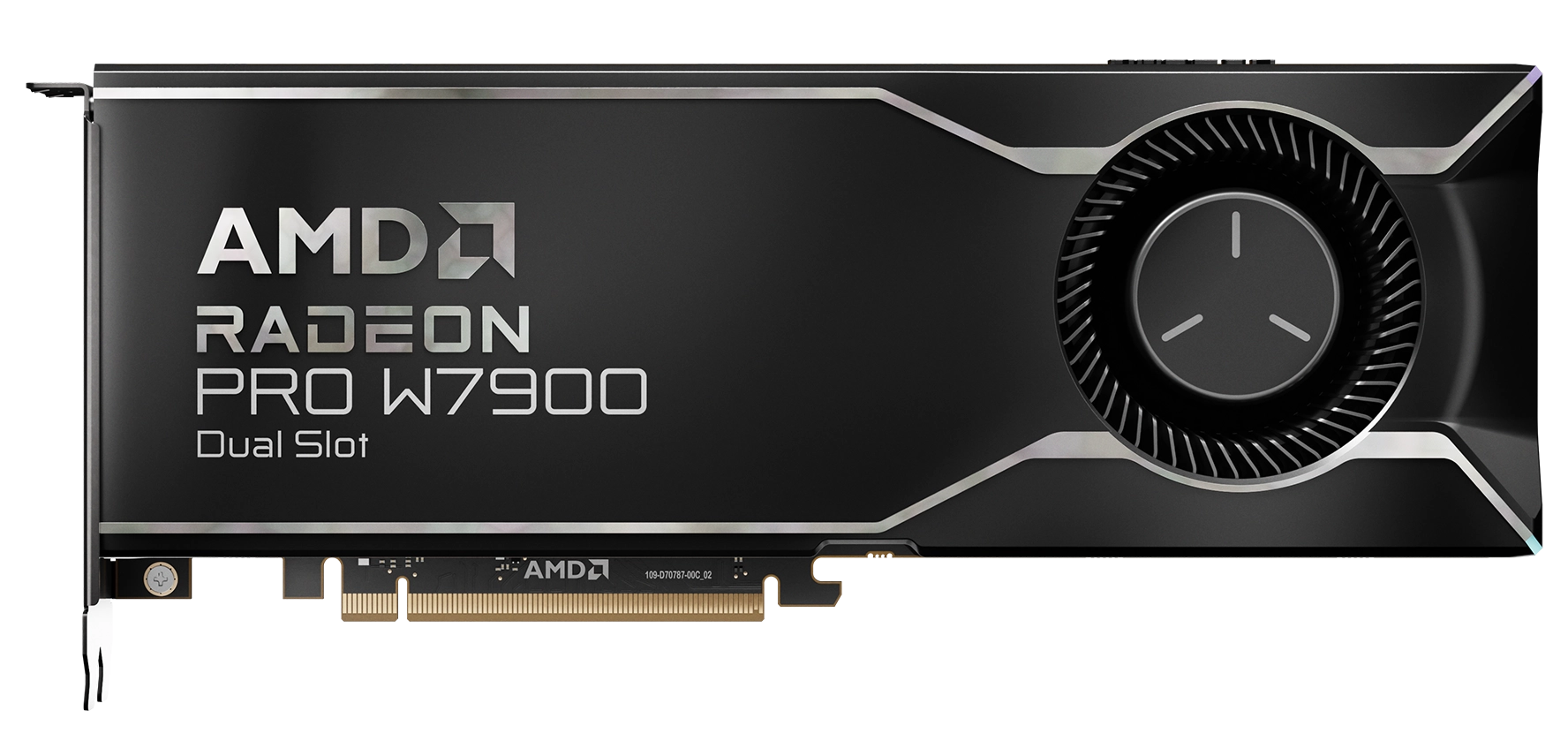
Radeon Pro W7900
The W7900 is the most powerful high-end card in the Radeon Pro W7000 range. Based on the RDNA 3 architecture, the W7900 has 6,144 stream processors, 192 AI accelerators and 96 ray accelerators plus 48GB of ultra-reliable GDDR6 ECC memory. The W7900 features 96MB of L3 Infinity Cache and supports four high resolution displays, making this card the perfect choice for very high-end workstations.
Visualisation Performance (X / 10)
Double Precision FP64 Performance (TFLOPS)
Single Precision FP32 Performance (TFLOPS)
Half Precision FP16 Performance (TFLOPS)
AI INT4 Performance (TOPS)
VR Ready
Hi-Res Display Support
Support for 8K video projects and up to six 4K HDR displays via AMD Infinity Cache technology, holding frequently reused data in high-speed GPU memory.
Ray Tracing
The Ray Accelerator is a high-performance raytracing acceleration architecture. This specialised hardware handles the intersection of rays directly on AMD Radeon Pro GPUs.
VR Ready
AMD Radeon ReLive for VR technology gives untethered freedom to naturally navigate creations as you would in the real world — without worrying about wires or base stations.
Remote Working
Access the full GPU-accelerated experience of Radeon Pro workstations from virtually anywhere with the remote workstation IP built into AMD Software Pro Edition.
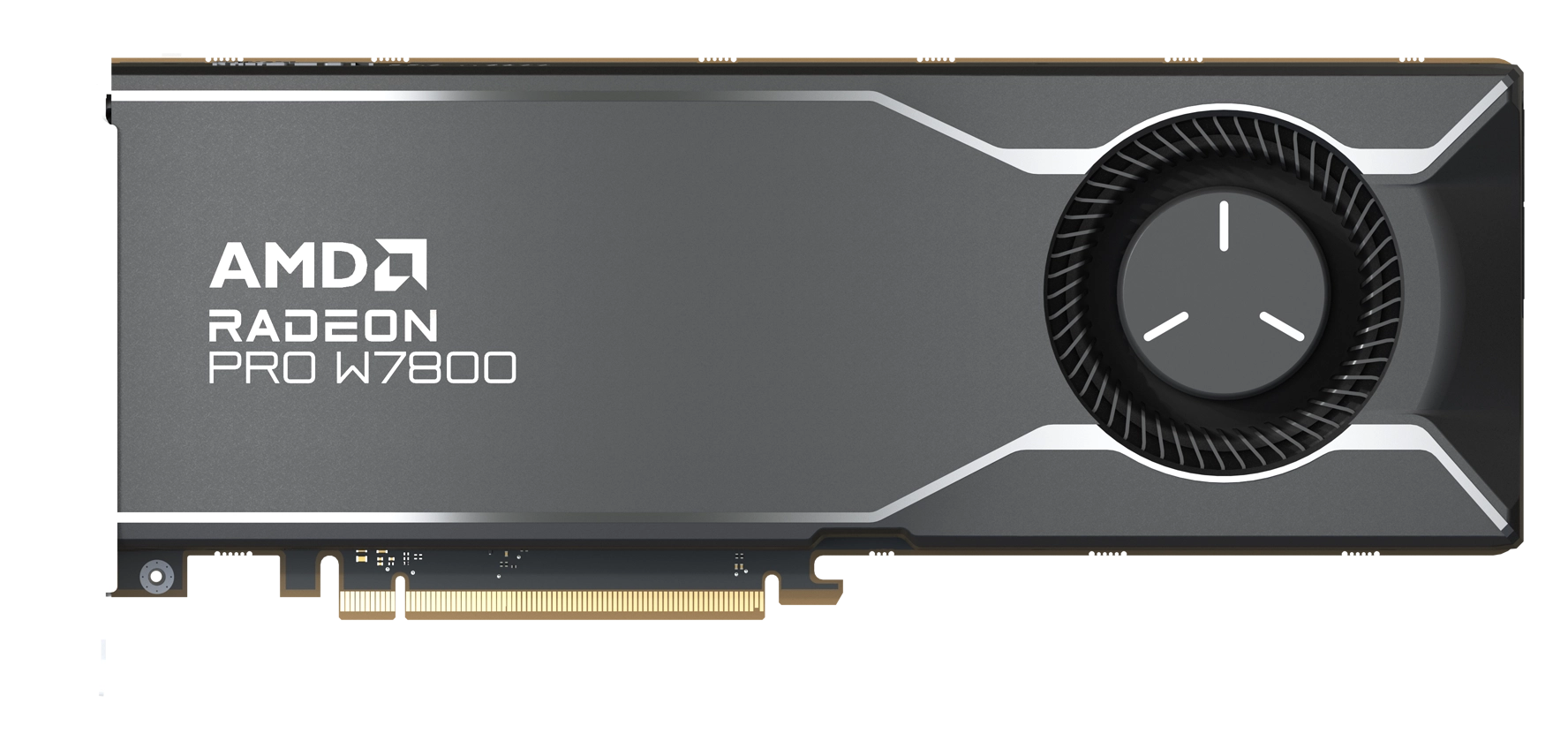
Radeon Pro W7800
The W7800 is the second-most powerful card in the Radeon Pro W7000 range. Based on the RDNA 3 architecture, the W7800 has 4,480 stream processors, 140 AI accelerators and 70 ray accelerators plus 32GB of ultra-reliable GDDR6 ECC memory. The W7800 features 64MB of L3 Infinity Cache and supports four high resolution displays, making it a great choice for high-end workstations.
Visualisation Performance (X / 10)
Double Precision FP64 Performance (TFLOPS)
Single Precision FP32 Performance (TFLOPS)
Half Precision FP16 Performance (TFLOPS)
AI INT4 Performance (TOPS)
VR Ready
Hi-Res Display Support
Support for 8K video projects and up to six 4K HDR displays via AMD Infinity Cache technology.
Ray Tracing
Specialised hardware handles the intersection of rays directly on AMD Radeon Pro GPUs for high-fidelity lighting.
VR Ready
AMD Radeon ReLive for VR enables untethered navigation of your creations without wires or base stations.
Remote Working
Access the full GPU-accelerated workstation experience from virtually anywhere via AMD Software Pro Edition.
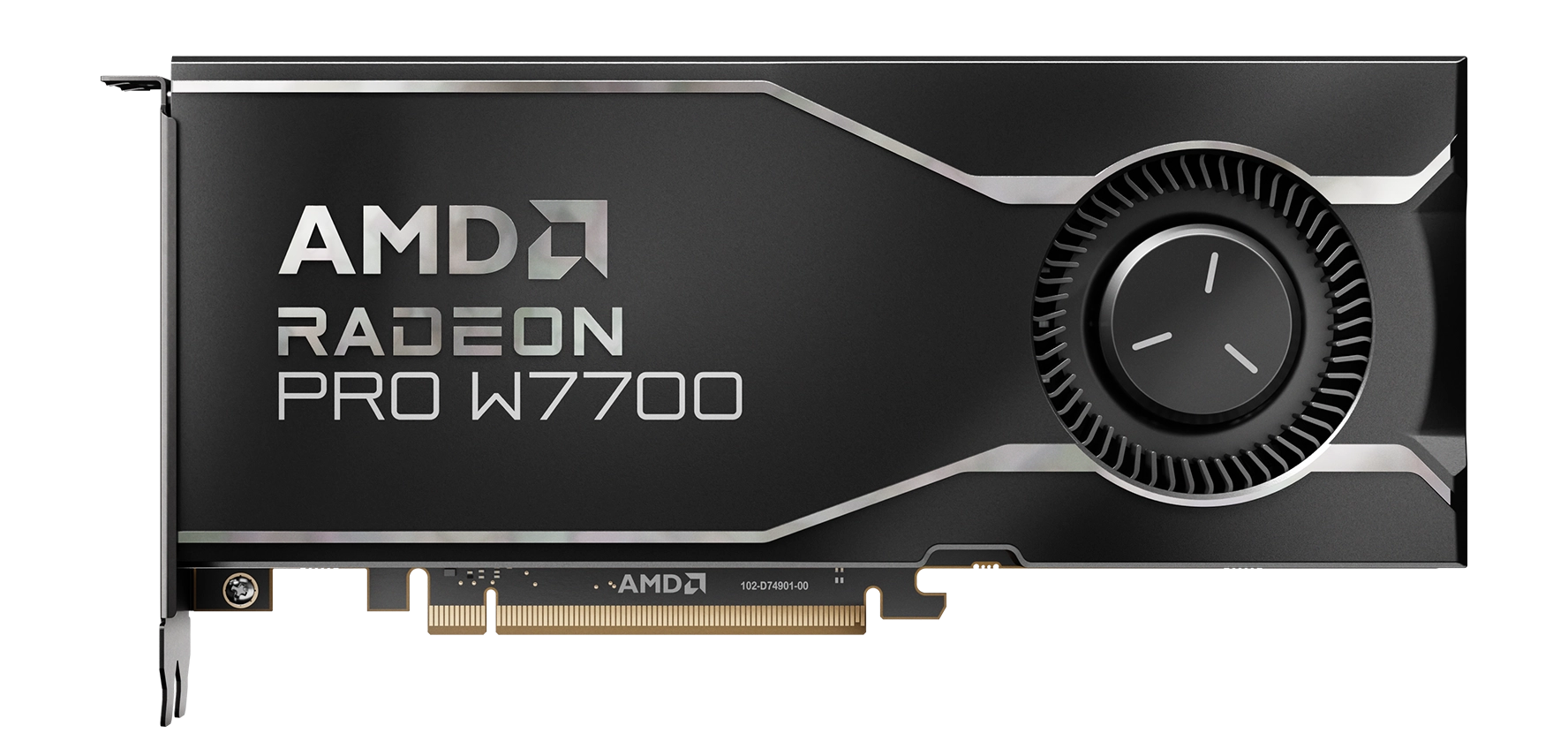
Radeon Pro W7700
The W7700 is the most powerful mid-range card in the Radeon Pro W7000 range. Based on the RDNA 3 architecture, the W7700 has 3,072 stream processors, 96 AI accelerators and 48 ray accelerators plus 16GB of ultra-reliable GDDR6 ECC memory. The W7700 features 64MB of L3 Infinity Cache and supports four high resolution displays, making it the perfect choice for mid-range workstations.
Visualisation Performance (X / 10)
Double Precision FP64 Performance (TFLOPS)
Single Precision FP32 Performance (TFLOPS)
Half Precision FP16 Performance (TFLOPS)
AI INT4 Performance (TOPS)
VR Ready
Hi-Res Display Support
Support for 8K video projects and up to six 4K HDR displays via AMD Infinity Cache technology.
Ray Tracing
Specialised hardware handles the intersection of rays directly on AMD Radeon Pro GPUs for high-fidelity lighting.
VR Ready
AMD Radeon ReLive for VR enables untethered navigation of your creations without wires or base stations.
Remote Working
Access the full GPU-accelerated workstation experience from virtually anywhere via AMD Software Pro Edition.
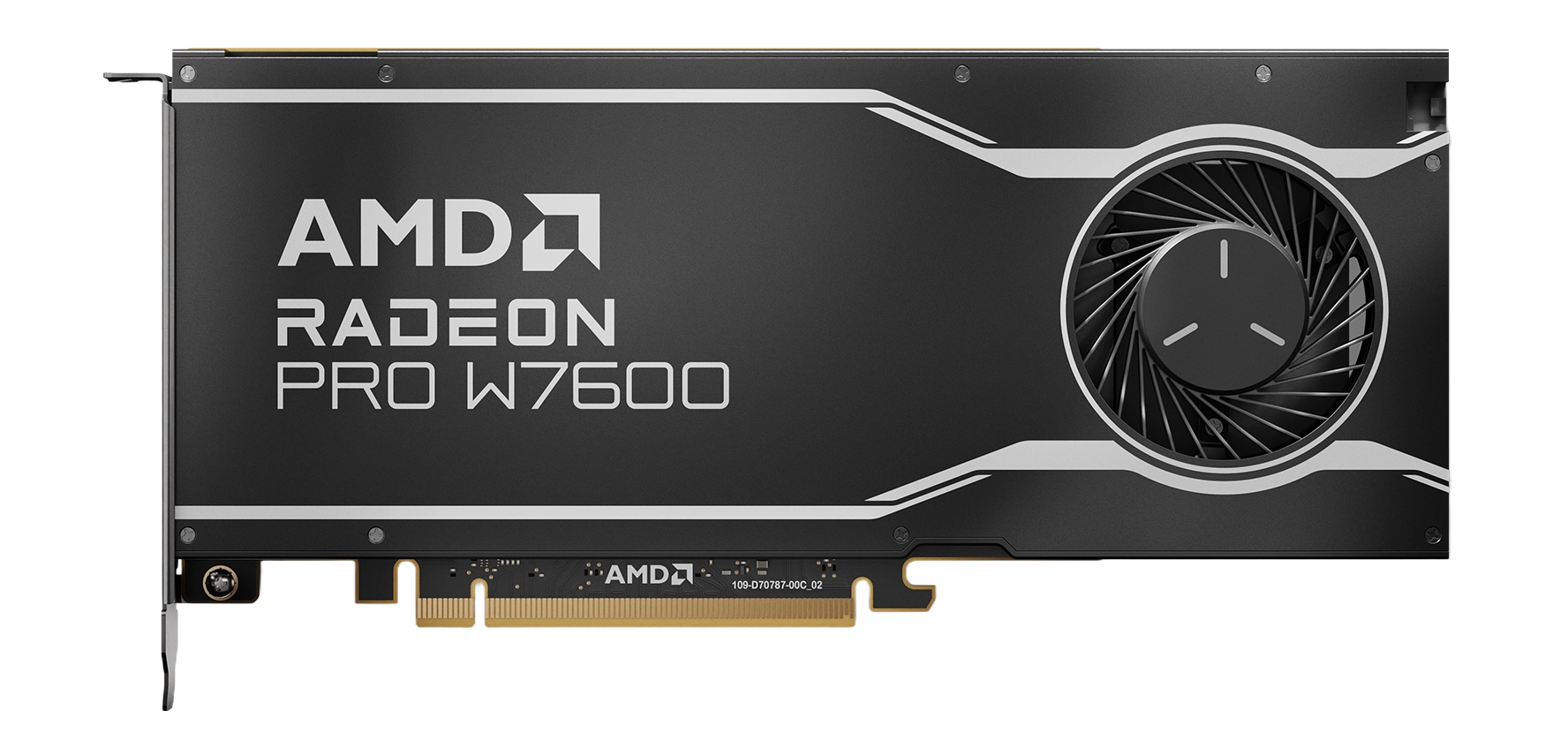
Radeon Pro W7600
The W7600 is the second most powerful mid-range card in the Radeon Pro W7000 range. Based on the RDNA 3 architecture, the W7600 has 2,048 stream processors, 64 AI accelerators and 32 ray accelerators plus 8GB of GDDR6 memory and PCIe 4.0 connectivity. The W7600 features 32MB of L3 Infinity Cache and supports four 4K or two 8K displays, making it a great choice for mid-range workstations.
Visualisation Performance (X / 10)
Double Precision FP64 Performance (TFLOPS)
Single Precision FP32 Performance (TFLOPS)
Half Precision FP16 Performance (TFLOPS)
AI INT4 Performance (TOPS)
VR Ready
Hi-Res Display Support
Support for four 4K or two 8K displays via AMD Infinity Cache technology.
Ray Tracing
Specialised hardware handles the intersection of rays directly on AMD Radeon Pro GPUs for high-fidelity lighting.
VR Ready
AMD Radeon ReLive for VR enables untethered navigation of your creations without wires or base stations.
Remote Working
Access the full GPU-accelerated workstation experience from virtually anywhere via AMD Software Pro Edition.
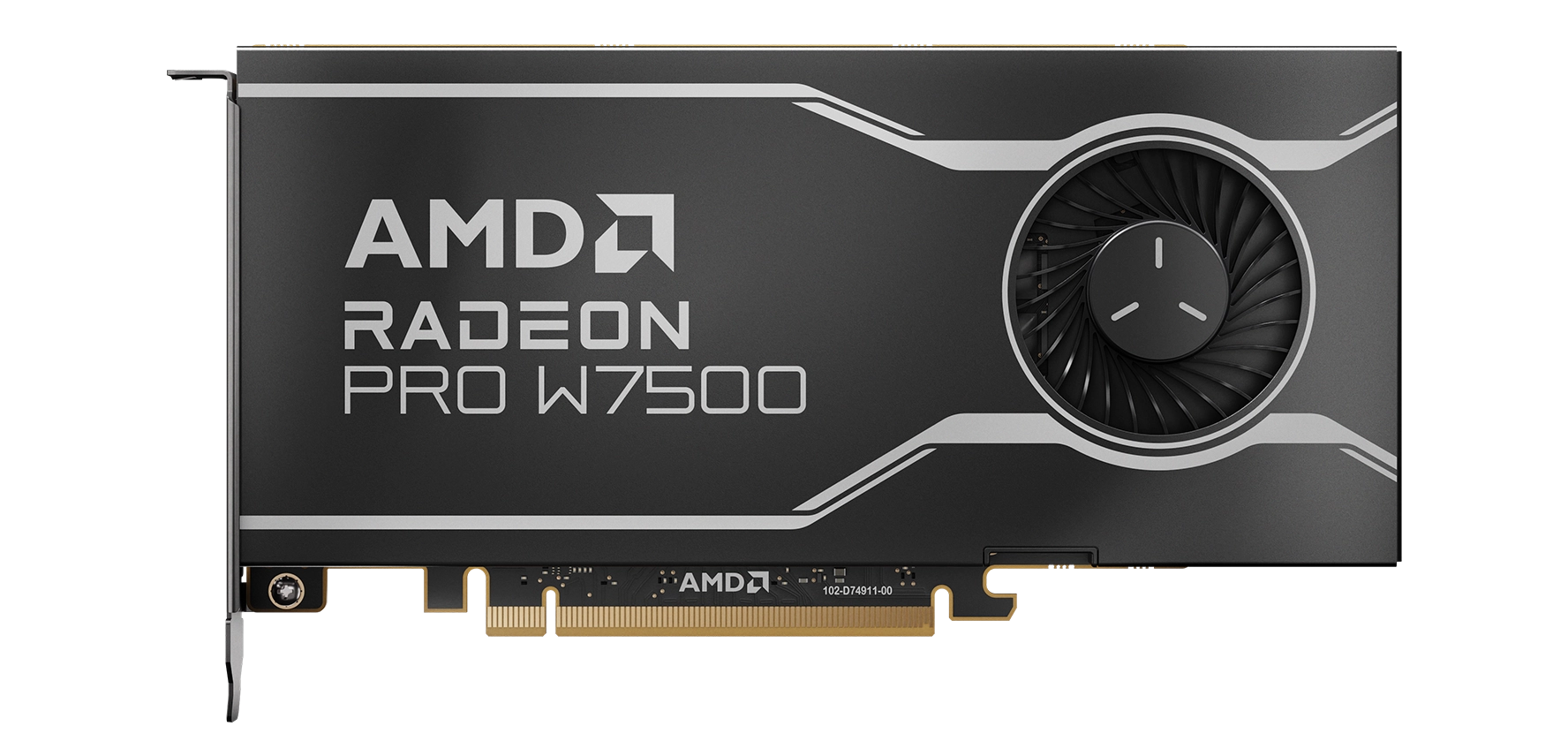
Radeon Pro W7500
The third most powerful mid-range card in the Radeon Pro range is the W7500. Based on the RDNA 3 architecture, the W7500 has 1,792 stream processors, 56 AI accelerators and 28 ray accelerators plus 8GB of GDDR6 memory and PCIe 4.0 connectivity. The W7500 features 32MB of L3 Infinity Cache and supports four 4K or two 8K displays, making it a good choice for mid-range workstations.
Visualisation Performance (X / 10)
Double Precision FP64 Performance (TFLOPS)
Single Precision FP32 Performance (TFLOPS)
Half Precision FP16 Performance (TFLOPS)
AI INT4 Performance (TOPS)
VR Ready
Hi-Res Display Support
Support for four 4K or two 8K displays via AMD Infinity Cache technology.
Ray Tracing
Specialised hardware handles the intersection of rays directly on AMD Radeon Pro GPUs for high-fidelity lighting.
VR Ready
AMD Radeon ReLive for VR enables untethered navigation of your creations without wires or base stations.
Remote Working
Access the full GPU-accelerated workstation experience from virtually anywhere via AMD Software Pro Edition.
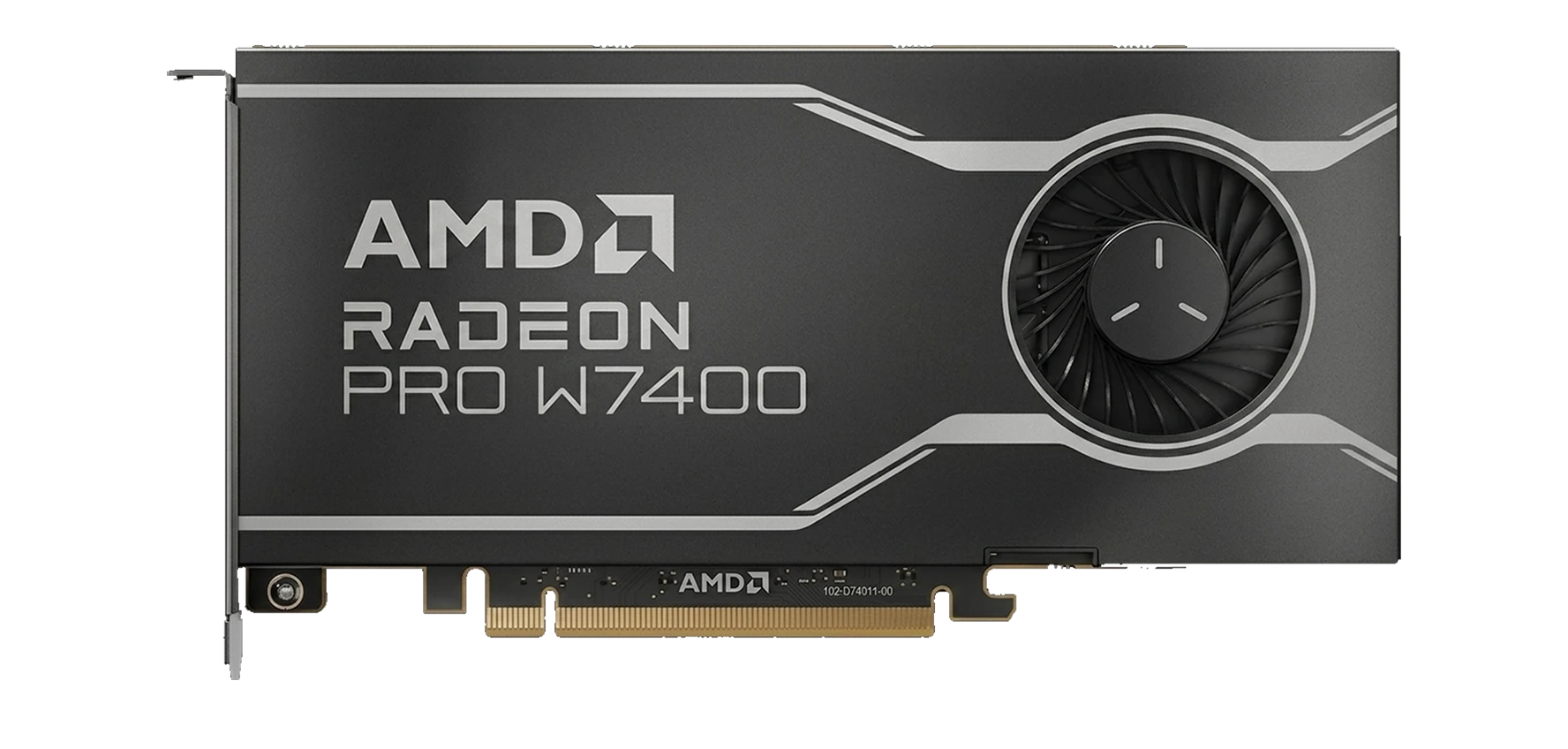
Radeon Pro W7400
The entry-level card in the Radeon Pro range is the W7400. Based on the RDNA 3 architecture, the W7400 has 1,792 stream processors, 56 AI accelerators and 28 ray accelerators plus 8GB of GDDR6 memory and PCIe 4.0 connectivity. The W7400 features 32MB of L3 Infinity Cache and supports four 4K or two 8K displays, making this card a good choice for entry-level workstations.
Visualisation Performance (X / 10)
Double Precision FP64 Performance (TFLOPS)
Single Precision FP32 Performance (TFLOPS)
Half Precision FP16 Performance (TFLOPS)
AI INT4 Performance (TOPS)
VR Ready
Hi-Res Display Support
Supports two 4K or a single 8K display via AMD Infinity Cache technology — ideal for entry-level professional use.
Ray Tracing
Specialised hardware handles the intersection of rays directly on AMD Radeon Pro GPUs for high-fidelity lighting.
VR Ready
AMD Radeon ReLive for VR enables untethered navigation of your creations without wires or base stations.
Remote Working
Access the full GPU-accelerated workstation experience from virtually anywhere via AMD Software Pro Edition.
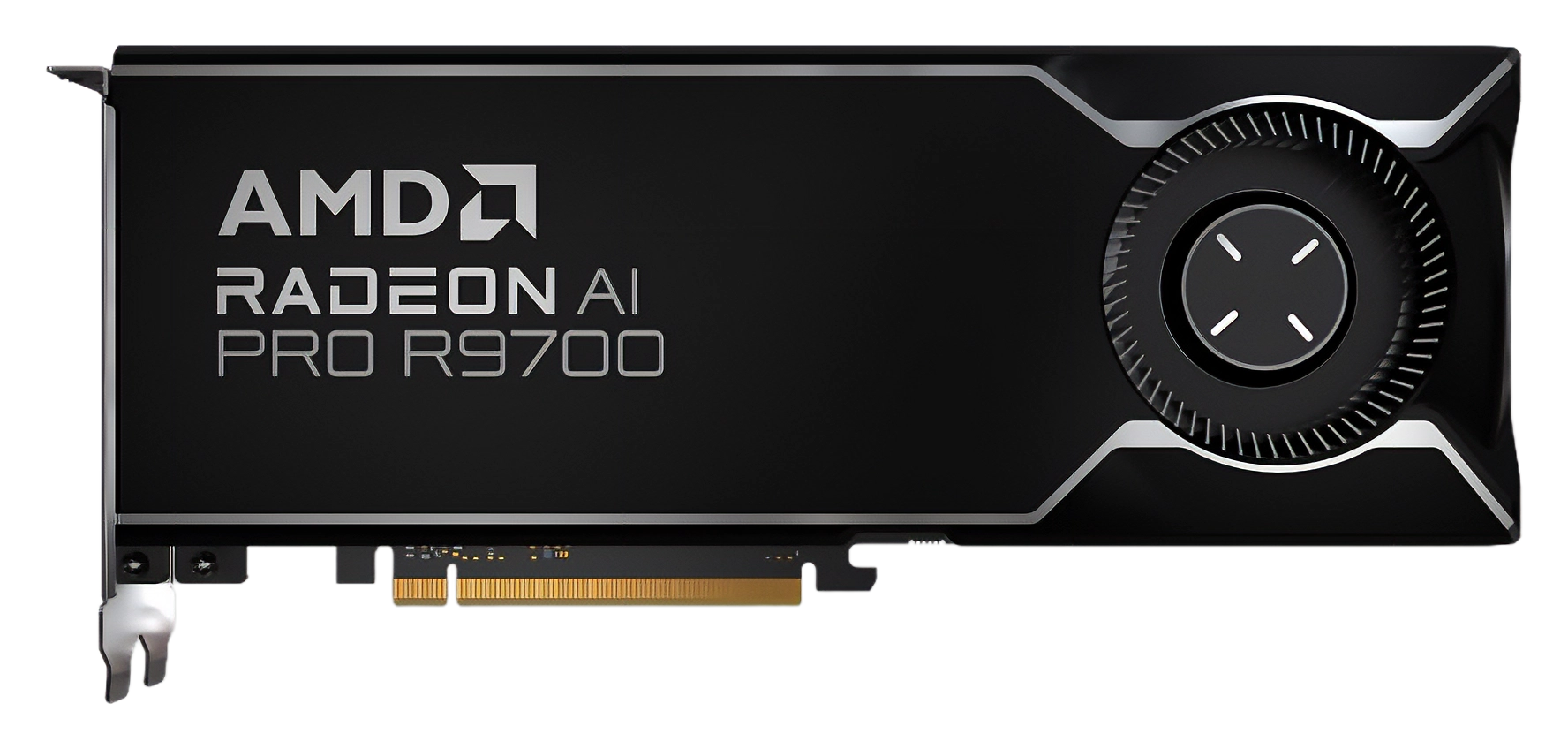
Radeon AI Pro R9700
The R9700 is a dedicated AI accelerator. Based on the RDNA 4 architecture, the R9700 has 4,096 stream processors, 128 AI accelerators and 64 ray accelerators plus 32GB of GDDR6 memory. It features 64MB of L3 Infinity Cache and supports four high resolution displays. Where it really shines is in AI inferencing workloads — it is an order of magnitude faster than W-series cards — making it a great choice for an AI workstation.
Visualisation Performance (X / 10)
Double Precision FP64 Performance (TFLOPS)
Single Precision FP32 Performance (TFLOPS)
Half Precision FP16 Performance (TFLOPS)
AI INT4 Performance (TOPS)
VR Ready
AI Accelerator
Powered by RDNA 4, the R9700 delivers over 4x more AI compute than RDNA 3. Featuring two AI accelerators per compute unit, support for new data types, and sparsity.
Large VRAM
Equipped with 32GB of memory for scaling up to larger AI models and advanced workflows, enabling broader on-device AI capabilities without compromise.
Software Ecosystem
The R9700 supports major machine learning frameworks including Microsoft DirectML and the AMD ROCm open software platform.
Remote Working
Access the full GPU-accelerated workstation experience from virtually anywhere via AMD Software Pro Edition.
AMD Radeon Pro GPU Full Specification Summary
The table below summarises each GPU's performance alongside full technical specifications.
| Specification | W7900 | W7800 | W7700 | W7600 | W7500 | W7400 | R9700 |
|---|---|---|---|---|---|---|---|
| Visualisation (X / 10) | 10 | 9 | 6 | 5 | 3 | 2 | 10 |
| FP64 (TFLOPS) | 1.9 | 1.3 | 1.0 | 0.6 | 0.4 | ✖ | N/A |
| FP32 (TFLOPS) | 61.3 | 45.2 | 28.3 | 21.4 | 17.3 | 12.2 | 47.8 |
| FP16 (TFLOPS) | 122.6 | 90.5 | 56.5 | 42.8 | 34.6 | 24.4 | 95.7 |
| AI INT4 (TOPS) | 245 | 181 | 113 | 86 | 69 | ✖ | 1,531 |
| VR Ready | ✔ | ✔ | ✔ | ✔ | ✔ | ✔ | ✔ |
| Architecture | RDNA 3 | RDNA 3 | RDNA 3 | RDNA 3 | RDNA 3 | RDNA 3 | RDNA 4 |
| GPU | Navi 31 | Navi 31 | Navi 32 | Navi 33 | Navi 33 | Navi 33 | Navi 48 |
| Stream Processors | 6,144 | 4,480 | 3,072 | 2,048 | 1,792 | 1,792 | 4,096 |
| AI Accelerators | 192 (1st Gen) | 140 (1st Gen) | 96 (1st Gen) | 64 (1st Gen) | 56 (1st Gen) | 56 (1st gen) | 128 (2nd Gen) |
| Ray Accelerators | 96 (2nd Gen) | 70 (2nd Gen) | 48 (2nd Gen) | 32 (2nd Gen) | 28 (2nd Gen) | 28 (2nd gen) | 64 (3rd Gen) |
| Memory | 48GB GDDR6 | 32GB GDDR6 | 16GB GDDR6 | 8GB GDDR6 | 8GB GDDR6 | 8GB GDDR6 | 32GB GDDR6 |
| ECC Memory | ✔ | ✔ | ✔ | ✖ | ✖ | ✖ | ✔ |
| Memory Controller | 384-bit | 256-bit | 256-bit | 128-bit | 128-bit | 128-bit | 256-bit |
| TDP | 295W | 260W | 190W | 130W | 70W | 55W | 300W |
| Minimum PSU | 750W | 700W | 650W | 500W | 450W | 450W | 750W |
| Release Date | Apr 2023 | Apr 2023 | Apr 2023 | Apr 2023 | Apr 2023 | Aug 2025 | July 2025 |
| Price |
|
|
|
|
|
TBC | From £1,300 |
| Shop | Buy | Buy | Buy | Buy | Buy | Buy | View |
✔ = Supported | ✖ = Not supported
Ready to Buy?
Browse our full range of AMD workstation GPUs , available standalone or factory-integrated into a 3XS workstation by our expert team.
Shop AMD Workstation GPUs
Browse the range of standalone graphics cards to upgrade the performance of your existing workstations in demanding graphics, compute and AI applications.
Shop Now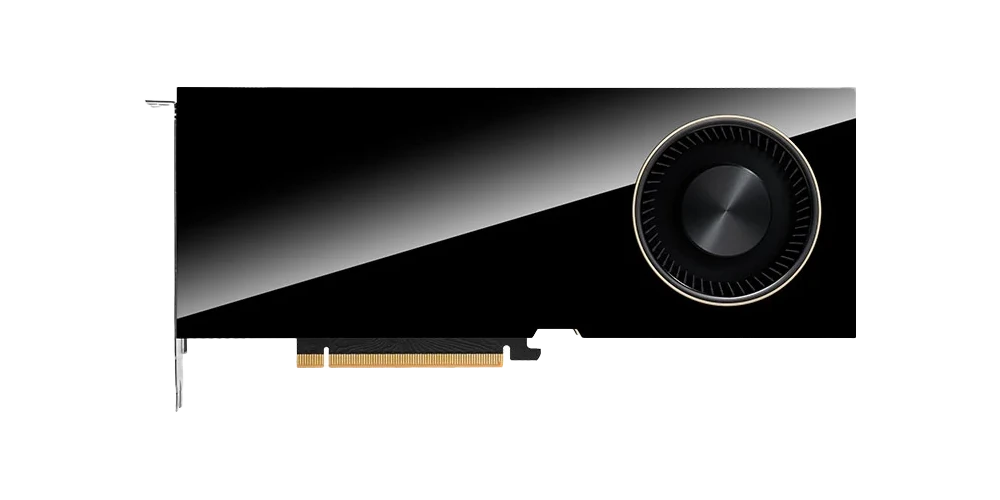
Graphics Workstations
Pre-built or bespoke 3XS graphics workstations powered by AMD — built for 3D CAD, CAE and media & entertainment workflows.
View Range Configure Now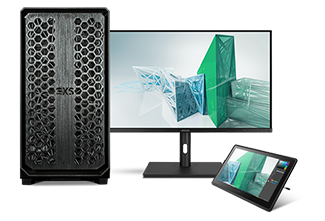
Video Workstations
Pre-built or bespoke 3XS video workstations powered by AMD — delivering real-time playback, faster renders and seamless HD, 4K & 8K editing.
View Range Configure Now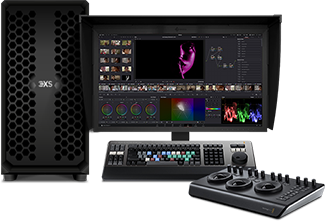
AI Workstations
Pre-built or bespoke 3XS AI workstations powered by AMD — built for model training, inferencing and deep learning workflows.
View Range Configure Now
Need Help Choosing?
If you need advice on selecting the right GPU or configuring your ideal workstation, our friendly advisors are happy to help.
Frequently Asked Questions
Common questions about AMD Radeon Pro GPUs and workstation graphics to help you make a confident buying decision.
The graphics card is the most important component in a workstation PC as it's responsible for rendering applications, performing simulations and running AI models. More powerful graphics cards enable you to work at higher resolutions and produce higher frame rates, improving user experience. A graphics card comprises two main components — the GPU (Graphics Processing Unit), effectively the brain of the card, plus VRAM (Video Random Access Memory) which the GPU uses to store data such as models, textures and buffered rendered frames.
AMD Radeon Pro is a range of graphics cards designed for professional graphics workloads such as AEC & BIM, CAD & CAE, Media & Entertainment and video production. They differ from Radeon cards (which are designed for gaming) by having ISV-certified drivers, super reliable ECC memory and larger frame buffers for loading complex projects into memory.
Radeon graphics cards are designed for gaming, while Radeon Pro cards are designed for professional graphics workloads such as AEC & BIM, CAD & CAE, Media & Entertainment and video production. They differ from Radeon cards (which are designed for gaming) by having ISV-certified drivers, super reliable ECC memory and larger frame buffers for loading complex projects into memory.
Workstation graphics cards are expensive because they are designed and built for commercial rather than consumer operation. Their higher pricing reflects greater memory capacities, more reliable hardware, certified software, and enterprise-level technical support.
Yes, although AMD Radeon Pro graphics cards are designed for professional graphics workloads, they are based on the same RDNA architecture as Radeon cards, so can be used for gaming.
A stream processor is the primary processor inside AMD Radeon GPUs responsible for rendering graphics and other tasks. Each GPU has thousands of stream processors working together in parallel — the more cores, the higher the performance. Some tasks are accelerated by specialist ray accelerators or AI accelerators. You can see how advanced the architecture is by name: RDNA 4 (2025), RDNA 3 (2023), RDNA 2 (2022).
Ray accelerators work alongside stream processors to accelerate ray traced effects in applications. Unlike traditional rasterised graphics, ray tracing simulates how light beams and shadows actually work, providing far richer and more realistic visuals. The more ray accelerators, the faster the frame rate when ray tracing is enabled. GPU generation (e.g. 3rd Gen vs 2nd Gen) indicates how advanced the ray accelerators are.
AI accelerators work alongside stream processors to accelerate AI workloads and applications. The more AI accelerators, the faster the AI performance. Like ray accelerators, generation number indicates advancement — 2nd Gen AI accelerators (found in the R9700) are significantly more capable than 1st Gen (found in W7000-series cards).
FSR (Fidelity Super Resolution) is an advanced AI-powered rendering technique unique to AMD graphics cards that uses AI accelerators to increase frame rates. FSR enables you to ramp up resolution to enjoy higher quality graphics without sacrificing performance.
A FLOP (Floating-Point Operation per Second) measures how quickly a GPU calculates the complex maths behind simulations and AI model training. The more FLOPS, the faster the performance. Like RAM or storage, the count is shortened to GFLOPS (giga, 10⁹), TFLOPS (tera, 10¹²) and PFLOPS (peta, 10¹⁵).
These represent how precisely a floating-point calculation is performed. In order of increasing precision: FP4 (1/8th precision, fastest), FP8 (quarter precision), FP16 (half precision), FP32 (single precision) and FP64 (double precision, slowest but most accurate). Higher precision is generally used for scientific and engineering simulations; lower precision is used for AI inference and training.
A TOP (Trillion Operations per Second) measures how quickly a GPU can perform the integer maths commonly used when inferencing AI models. The more TOPS, the faster the AI inference performance. This is why the R9700's 1,531 TOPS is so significant compared to the W-series cards' 69–245 TOPS.