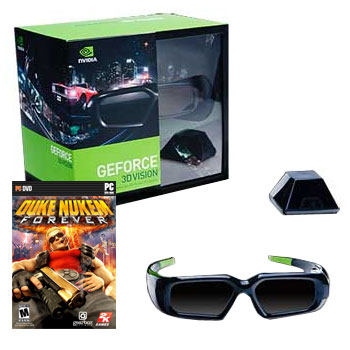
Nvidia GeForce 3D Vision Kit Glasses , IR Emitter and Duke Nukem Forever
Scan code: LN39906
Manufacturer code: 942-10701-0007-104
End Of Life

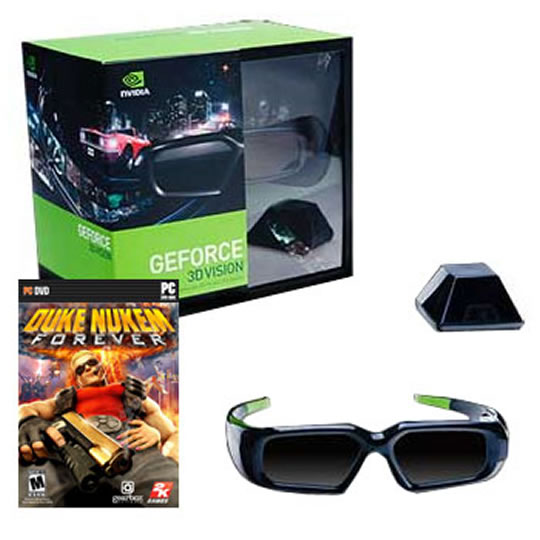

Nvidia GeForce 3D Vision Kit Glasses , IR Emitter and Duke Nukem Forever
Nvidia GeForce 3D Vision Kit Glasses IR Emitter & Duke Nukem Forever Game Needs 120Hz Monitor
Scan code:
LN39906
Manufacturer code:
942-10701-0007-104
This product is no longer available to purchase.
Email me when the availability or price changes
Product Overview
Tired of living in a 2D world?
http://www.nvidia.com/object/3d-vision-requirements.html
Upgrade your PC to a fully immersive stereoscopic 3D experience with NVIDIA® GeForce® 3D Vision™. A combination of high-tech wireless glasses and advanced software, GeForce 3D Vision automatically transforms hundreds of PC games into full stereoscopic 3D.
Just slip on the stylish glasses and pair them with an NVIDIA® GeForce® GPU and a "GeForce 3D Vision-Ready" display to experience characters and environments come to life on the screen.
In addition, you can watch 3D movies and 3D digital photographs in eye popping, crystal-clear quality. Give your eyes something to talk about with GeForce 3D Vision. See what everyone is saying about GeForce 3D Vision or find a location to test drive for yourself.
** Important **
• The Nvidia GeForce 3D glasses require a compatible 120Hz LCD Monitor or DLP projector to function.
• Requires Nvidia GeForce 8800 GTX or above Graphics Card Features GeForce 3D Vision Specifications
Glasses
• Wireless
-Infrared receiver: Receive signal between 1.5 and 15 feet
• Power
-Battery Life: 40 hours of stereoscopic 3D
-Power button: On button
-Rechargeable battery connector: USB 2.0 mini-B power connector
• Indicator Lights
-Battery Level: Green and red indicator lights
-Charging: Amber light
• Dimensions
-Product Dimensions: 20.3’’x 16.6’’x 8.2’’
-Weight: 50 grams
IR Emitter
• Wireless
-Infrared transmitter: Transmit signal between 1.5 and 15 feet
• Buttons
-NVIDIA backlit button: GeForce 3D Vision on/off
-Depth Adjustment: Thumbwheel on the back of IR emitter
• Connectors
-USB 2.0 mini-B Connect to the PC for enabling GeForce 3D Vision
-VESA Stereo Cable Port - For use with DLP HDTV only
• Dimensions
-Product Dimensions: 2.5” X 2.5” X 1.5” tall
-Product Weight: 47 grams
Minimum requirements
• Microsoft® Windows® Vista 32/64-bit or Windows 7 32/64-bit
• Intel® Core™2 Duo or AMD Athlon™ X2 CPU or higher
• Graphics card supporting 3D Vision
• 1GB of system memory. (2GB is recommended)
• 100 MB free disk space
• Compatible 120Hz LCD Monitor or DLP projector
http://www.nvidia.com/object/3d-vision-requirements.html
Upgrade your PC to a fully immersive stereoscopic 3D experience with NVIDIA® GeForce® 3D Vision™. A combination of high-tech wireless glasses and advanced software, GeForce 3D Vision automatically transforms hundreds of PC games into full stereoscopic 3D.
Just slip on the stylish glasses and pair them with an NVIDIA® GeForce® GPU and a "GeForce 3D Vision-Ready" display to experience characters and environments come to life on the screen.
In addition, you can watch 3D movies and 3D digital photographs in eye popping, crystal-clear quality. Give your eyes something to talk about with GeForce 3D Vision. See what everyone is saying about GeForce 3D Vision or find a location to test drive for yourself.
** Important **
• The Nvidia GeForce 3D glasses require a compatible 120Hz LCD Monitor or DLP projector to function.
• Requires Nvidia GeForce 8800 GTX or above Graphics Card Features GeForce 3D Vision Specifications
Glasses
• Wireless
-Infrared receiver: Receive signal between 1.5 and 15 feet
• Power
-Battery Life: 40 hours of stereoscopic 3D
-Power button: On button
-Rechargeable battery connector: USB 2.0 mini-B power connector
• Indicator Lights
-Battery Level: Green and red indicator lights
-Charging: Amber light
• Dimensions
-Product Dimensions: 20.3’’x 16.6’’x 8.2’’
-Weight: 50 grams
IR Emitter
• Wireless
-Infrared transmitter: Transmit signal between 1.5 and 15 feet
• Buttons
-NVIDIA backlit button: GeForce 3D Vision on/off
-Depth Adjustment: Thumbwheel on the back of IR emitter
• Connectors
-USB 2.0 mini-B Connect to the PC for enabling GeForce 3D Vision
-VESA Stereo Cable Port - For use with DLP HDTV only
• Dimensions
-Product Dimensions: 2.5” X 2.5” X 1.5” tall
-Product Weight: 47 grams
Minimum requirements
• Microsoft® Windows® Vista 32/64-bit or Windows 7 32/64-bit
• Intel® Core™2 Duo or AMD Athlon™ X2 CPU or higher
• Graphics card supporting 3D Vision
• 1GB of system memory. (2GB is recommended)
• 100 MB free disk space
• Compatible 120Hz LCD Monitor or DLP projector


