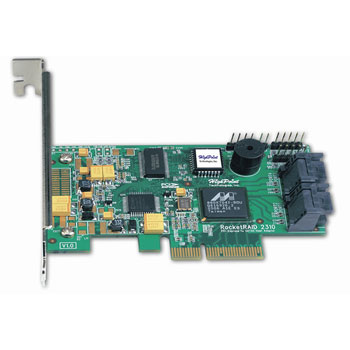
Highpoint RocketRAID 2310(RR2310) 4 channel Internal PCI-e x4 to SATA II RAID controller(card)
Scan code: LN13553
Manufacturer code: RocketRaid 2310
End Of Life

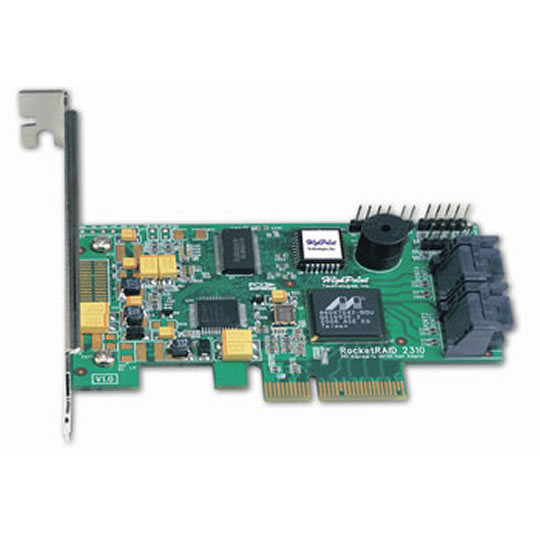

Highpoint RocketRAID 2310(RR2310) 4 channel Internal PCI-e x4 to SATA II RAID controller(card)
Highpoint RocketRAID 2310 (RR2310) 4 channel Internal PCI-e x4 to SATA II RAID controller(card)
Scan code:
LN13553
Manufacturer code:
RocketRaid 2310
This product is no longer available to purchase.
Email me when the availability or price changes
Product Overview
The HighPoint RocketRAID 2310 PCI Express to SATA II RAID Controller is the next generation for high performance computing solutions utilizing the latest interconnect PCI-Express.
The RocketRAID 2310 is set to give much faster and improved I/O and supports features that are critical for high performance computing, high end workstation and enterprise storage server environments.
PCI Express delivers data transfer in both directions simultaneously with its serial data transfer system and brings with it higher clock speeds.
Each expansion slot in PCI Express can have several channels which gives plenty of room for expansion. There is also the same data rate in both directions providing the performance and sca-lability for the next decade. Features Host Side Interface: PCI Express X4 (X8 and X16 slot compatible)
Device Interface: 4 x SATA II / SATA I hard drive support
RAID Support: RAID level 0, 1, 5, 10 and JBOD
Online Capacity Expansion and Online RAID Level Migration (OCE/ORLM)
Native Command Queuing (NCQ)
SAF-TE enclosure management
Hard drive activity and Failed LED support
Staggered drive spin-up support
Hot swap and hot spare
Write-through and write-back cache support
Quick and Background initialization for quick RAID configuration
Online array roaming
BIOS booting support (INT13)
64bit LBA for over 2TB support
Automatic RAID rebuild of failed drive
S.M.A.R.T drive monitoring for status and reliability
Browser-based RAID management software
Command Line Interface (CLI)
SMTP for email notification
Operating system support for Windows, Windows x64 Editions, Linux (open source) and FreeBSD (open source) and Mac OS X
The RocketRAID 2310 is set to give much faster and improved I/O and supports features that are critical for high performance computing, high end workstation and enterprise storage server environments.
PCI Express delivers data transfer in both directions simultaneously with its serial data transfer system and brings with it higher clock speeds.
Each expansion slot in PCI Express can have several channels which gives plenty of room for expansion. There is also the same data rate in both directions providing the performance and sca-lability for the next decade. Features Host Side Interface: PCI Express X4 (X8 and X16 slot compatible)
Device Interface: 4 x SATA II / SATA I hard drive support
RAID Support: RAID level 0, 1, 5, 10 and JBOD
Online Capacity Expansion and Online RAID Level Migration (OCE/ORLM)
Native Command Queuing (NCQ)
SAF-TE enclosure management
Hard drive activity and Failed LED support
Staggered drive spin-up support
Hot swap and hot spare
Write-through and write-back cache support
Quick and Background initialization for quick RAID configuration
Online array roaming
BIOS booting support (INT13)
64bit LBA for over 2TB support
Automatic RAID rebuild of failed drive
S.M.A.R.T drive monitoring for status and reliability
Browser-based RAID management software
Command Line Interface (CLI)
SMTP for email notification
Operating system support for Windows, Windows x64 Editions, Linux (open source) and FreeBSD (open source) and Mac OS X


